
One century ago this week, the March 5, 1921 edition of “Exhibitors Herald” took note of an extraordinary effort to coordinate all facets of the motion picture production industry in a joint effort to head off the threat of movie censorship.
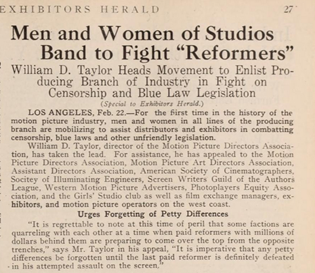
The effort was headed by William Desmond Taylor, a prolific and respected Hollywood director who was serving as director of the Motion Picture Directors Association. The industry’s initial bid to thwart would-be censors had been a legal challenge on constitutional grounds. In the case of Mutual Film v. Ohio Industrial Commission, industry lawyers argued that movie censorship constituted a violation of First Amendment protections. This argument did not prevail, however. The Supreme Court held that motion pictures were not entitled to First Amendment protection. Variety reported the verdict in February of 1915:
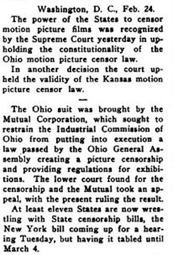
With legal challenges effectively foreclosed by the Mutual v. Ohio ruling, the fight against movie censorship pivoted, of necessity, to the political arena. If the courts would not stand in the way of the censors, the industry could perhaps exert pressure on politicians to take a stand against movie censorship as a matter of policy.
On this front, the industry fared somewhat better. While a number of states did in fact set up censorship boards, an organization called NAMPI (National Association of the Motion Picture Industry), formed in 1916, was able to meet with President Woodrow Wilson and secure from him a statement in opposition to movie censorship.

For the next few years, an ongoing political tug of war ensued, with Hollywood’s representatives sometimes gaining ground on the proponents of censorship and sometimes losing ground. The March 1921 effort led by William Desmond Taylor represented the latest big push against the arbiters of public morality.
The coming year, however, was not to be a salutary one for the industry. A series of scandals, including two particularly sensational and damaging ones, was to tarnish Hollywood’s public image in a way that would sharply cut against earning the public’s trust with respect to safeguarding public morals without the burden of government censorship.
The first was a charge of rape and manslaughter leveled at Roscoe Arbuckle, one of Hollywood’s top comedy stars. At a party hosted by Arbuckle on September 5, 1921, a young actress named Virginia Rappe died. The allegation was that she died as a result of a brutal rape committed by Arbuckle. The combination of salaciousness, alleged brutality, and a national celebrity was catnip to the press, and they did not hold back. The prosecution of Arbuckle received a sensationalistic level of coverage that is fully comparable to the O.J. Simpson trial some decades later.
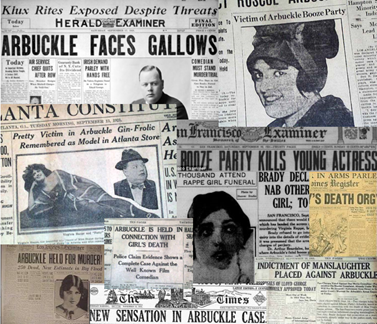
This scandal alone was enough to stir up and embolden censorship advocates, as “Variety” reported:
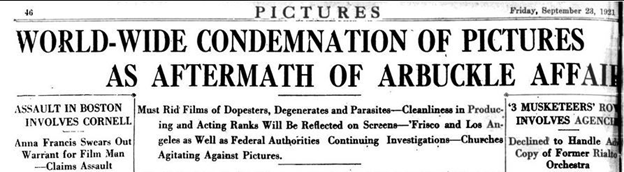
The fact that Arbuckle was ultimately acquitted in a third trial after two hung juries made little difference. In terms of public relations for the movie industry, the damage had been done.
But there was more to come.
On the morning of February 2, 1922, a noted Hollywood director was found dead in his bungalow. He had been shot with a small-caliber pistol the previous evening. Once again, the press had a sensationalistic Hollywood story handed to them, and once again they ran with it.
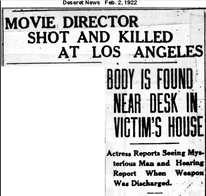
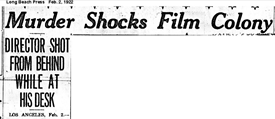
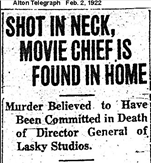
And as the investigation proceeded, the juicy details provided ever more fodder for the press:
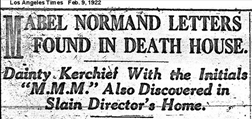
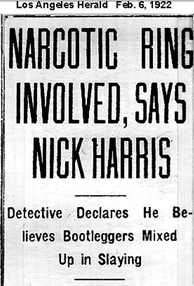
With this grisly narrative coming on the heels of the Arbuckle case (the Arbuckle jury was still deliberating when this story broke), the tide of public opinion began to turn emphatically against Hollywood.
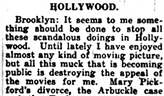
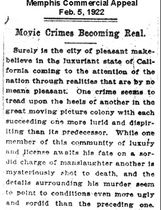
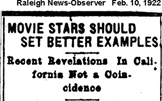
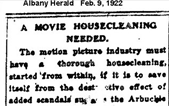
Suddenly, Hollywood found itself not only fighting a rear-guard action against more states setting up censorship boards, but also confronting head-on the very real prospect of the implementation of movie censorship on the federal level. With its back against the wall, the industry adopted a last-ditch fallback strategy. Rather than wait for the federal government to step in and implement a heavy-handed program of censorship, the industry would undertake a program of self-censorship. If they could sanitize the content of their films before they ever reached the state censorship boards, they could make a plausible case that federal censorship was not needed. This would ultimately lead to the implementation of the Motion Picture Production Code, the enforcement of which would keep the content of Hollywood movies squeaky clean so as to keep the censors at bay.
The one detail I haven’t mentioned is the name of the director whose sordid murder proved to be the straw that broke the back of Hollywood’s anti-censorship efforts. In an ironic plot twist that even the most hackneyed Hollywood screenwriter would blush to employ, the slain director was none other than the man who had led the charge against the censors — William Desmond Taylor.
