

One century ago this week, the December 11, 1923 edition of “The Film Daily” carried the following notice:
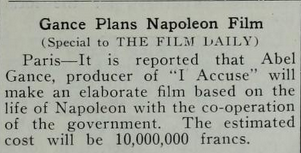
Abel Gance had already left an indelible mark on cinema history with his 1923 production LA ROUE, a towering achievement that for any other filmmaker might well have served as a career-high magnum opus. But Gance was only warming up. With his proposed NAPOLEON project, he had set his sights even higher. Originally he conceived of the project as a series of films on the life of Napoleon Bonaparte, as reported in the April 5, 1924 edition of “Motion Picture News”:
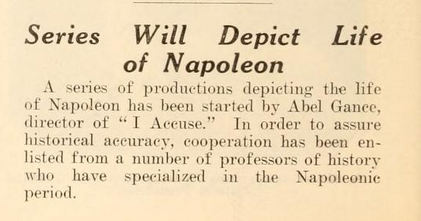
Gance initially planned on a sequence of six films, although as his conception expanded he would later speak of as many as eight films in the series. Of these, only the first would actually be completed, but it would turn out to be a monumental work for the ages.
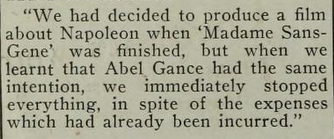
The news of Gance’s ambitious project was sufficient to prompt Paramount to abandon its own plans for a Napoleon film. Sydney Kent, a Paramount representative, was quoted to this effect in the December 2, 1924 edition of “The Film Daily”:
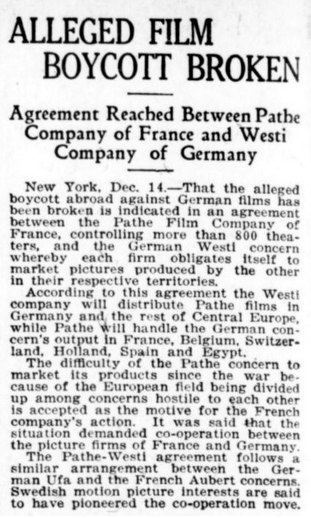
Funding a project of this magnitude proved to be an arduous undertaking. French film executive Charles Pathé had been willing to lend support to Gance’s work in the past, but this proposed budget was beyond his means. The project was rescued from oblivion, not by French funding, but rather by an infusion of cash from a consortium formed by two foreign businessmen – Wladimir Wengeroff, a Russian, and Hugo Stinnes of Germany. The German investment was noted by “The Film Daily” in its March 9, 1925 edition:
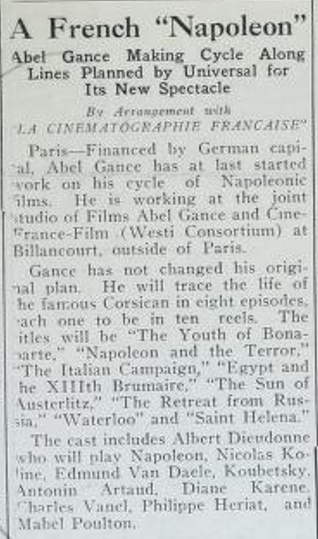
The name of the “Westi Consortium” mentioned in the article is a portmanteau of the names Wengeroff and Stinnes. The consortium’s prospects seemed promising. “The Billboard” reported in its December 20, 1924 edition that a distribution partnership with Pathé would be instrumental in overcoming reluctance to book films with German ties in countries that had been hostile to Germany during World War I.
With the Westi funding, plus what Pathé could provide, along with smaller contributions from a handful of other countries, Gance was able to cobble together sufficient backing to begin work.
A crisis arose, however, in mid-1925 when Westi fell on hard times. Hugo Stinnes had died, and his son, Egmund, was struggling to keep his father’s business interests afloat. The Westi Consortium was seen as low-hanging fruit by the investment bankers, and consequently Westi’s support for Gance’s film was withdrawn as of June of 1925. The failure of Westi was reported by “The Film Daily” in its October 14, 1925 edition:
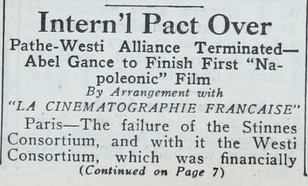
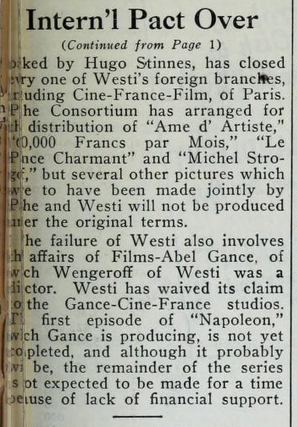
For a time it seemed that Gance’s project was doomed. Its resurrection, oddly enough, was once again due to the intervention of Russian investors. Alexander d’Arbeloff and his cousin, Jacques Grinieff, both Russian emigres, had formed a film company in France called Rodina. The name was derived from a Russian word, so to make the company seem more authentically French the name was changed to Société Générale des Films. Gance was able to obtain completion funds from SGF, but in the bargain he had to give up on the dream of planning multiple Napoleon films. This single film is all there would be.
But what a film it turned out to be. Gance had shot a prodigious amount of footage, and his original cut of the completed film is said to have run to seven hours in length. This had to be trimmed down, of course; Gance was bound by his deal with SGF to keep the release version within a reasonable length for commercial distribution. In addition, for certain scenes Gance had employed a widescreen triptych effect. Triptych imagery was, in itself, nothing new. Lois Weber had employed such an image way back in 1913 in her film SUSPENSE:
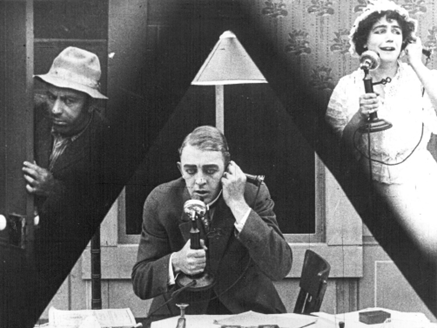
But Gance was not content to confine his triptychs to the standard 4:3 aspect ratio. Instead, he relied on a system of three synchronized projectors to create a triple-width image, like this:

Sometimes, as above, the three images would form one ultra-wide unified image, clearly prefiguring the Cinerama process of the 1950s, and sometimes the three images would be different, like this:
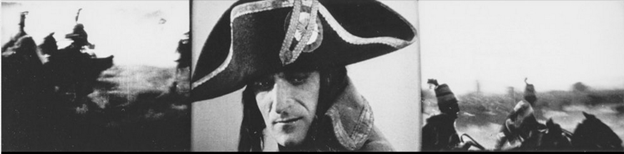
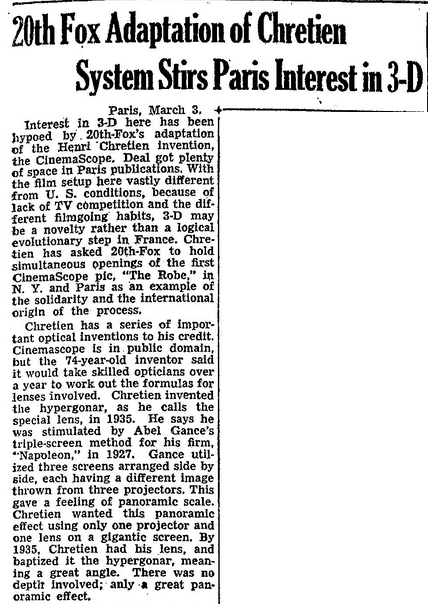
The process, which was called Polyvision, was undeniably impressive, but also difficult and costly for an exhibitor to present. Gance’s Polyvision was, by the way, an acknowledged inspiration for the development of the Hypergonar lens, an anamorphic lens designed to create widescreen images without the necessity of employing three projectors. Henri Chrétien, inventor of the Hypergonar lens, eventually sold the device to 20th Century Fox as the basis for its CinemaScope process. Chrétien explicitly acknowledged that Gance’s NAPOLEON had been his inspiration, as noted in this March 4, 1953 article in “Variety”:
United States distribution rights for NAPOLEON were acquired by MGM, as noted in the November 27, 1926 edition of “Motion Picture News”:
This sounds like good news, but it would ultimately prove to be otherwise. The film was enjoying successful runs in Europe, as reported in the January 1, 1928 edition of “The Film Daily”:
But the version that MGM screened in the United States bore little resemblance to the film Gance had delivered. The 3 ½ hour European version was summarily whittled down to less than half that length by MGM’s editors. Not only that, but scenes were also rearranged so that the film made little sense. Moreover, the Polyvision triptychs were dispensed with entirely. Only the center image from those scenes was projected. Gance’s outrage was duly noted in the industry press, as in the July 18, 1928 edition of “Variety”:
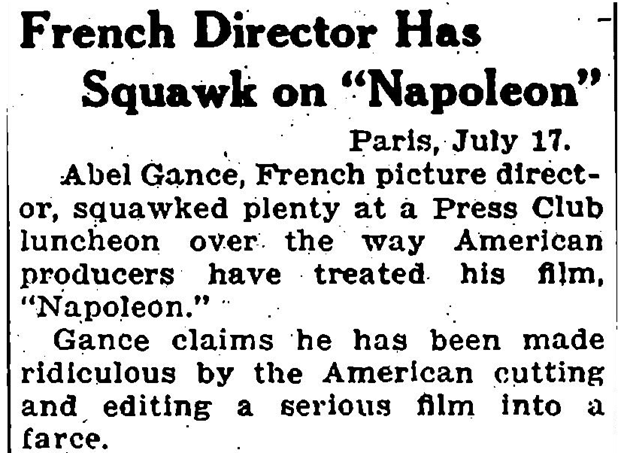
This mutilated version was, as one might expect, thoroughly roasted by reviewers. This review, from the February 2, 1929 edition of “Harrison’s Reports,” was typical:
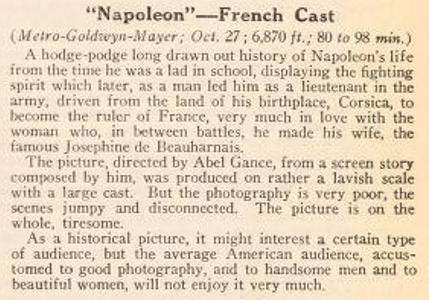
Note that the running time that is given is “80 to 98 minutes” (running times were approximate because silent projectors were frequently hand-cranked, so that running times varied from one theater to another).
The long-term survival of any silent film is a minor miracle, given that they were shot on a chemically unstable film stock called cellulose nitrate which has an unfortunate tendency to decompose over time. As a result of nitrate decomposition, more than 70% of all the feature length silent films ever made and released are permanently and irretrievably gone. If you include the many short films made before feature films became the norm, that figure rises to more than 90%. In the case of a film like NAPOLEON, which was sliced and diced into various mutilated versions, none of which included a majority of the scenes that had been shot, the prospect of ever seeing anything like a complete version is vanishingly small.
And yet, some years ago the British Film Institute released a 5 ½ hour reconstruction of the film, and there is encouraging talk of a 7 hour reconstruction yet to come. The miraculous reclamation of Gance’s epic work from the brink of extinction is due in large measure to the efforts of one man – Kevin Brownlow.
As a young film collector in London in the 1950s, Brownlow encountered a heavily abridged version of NAPOLEON. Despite the fragmentary nature of the print, Brownlow was captivated by Gance’s imagery. He eventually wrote to Gance and received a reply. His correspondence with Gance prompted him to embark on what would prove to be a decades-long quest to find and assemble missing elements of the film in order to assemble a restored full-length version. Amazingly, more and more bits and pieces of the film actually did turn up in usable condition. (This was partly because some of the fragments were on smaller film gauges that, unlike the theatrical 35mm format, were composed of the more chemically stable cellulose acetate stock.)
In August of 1979, Brownlow’s efforts culminated in a screening of a five-hour restoration of NAPOLEON at the Telluride film festival. Gance himself, at age 89, was in attendance. The screening included a Polyvision triptych screen for the climactic sequence. Since that time, additional footage has been found and incorporated and, as noted above, a version with still more footage is rumored to be in preparation.
Brownlow is one of the saints of the cinema; a seminal historian and documentarian with many impressive credits. Still, I would venture to guess that he would count his restoration of NAPOLEON as the crowning achievement of his long career. We are the fortunate beneficiaries of his dedication and hard work.
