

One century ago this week, the February 27, 1925 edition of “The Film Daily” carried the following item on its front page:
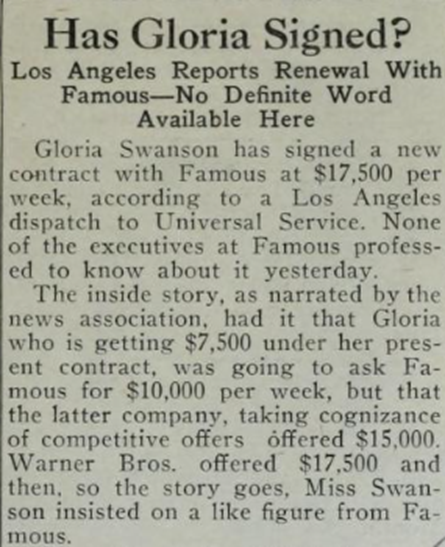
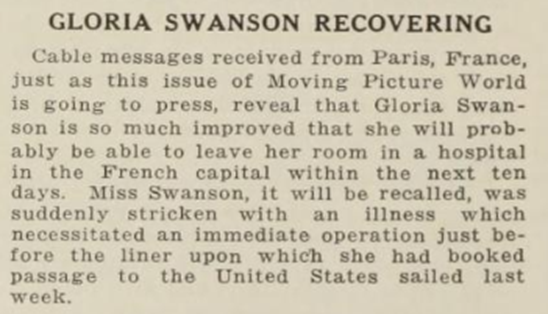
The question mark in the headline was a prudent hedge, because in point of fact Swanson had made no such deal. She had just gotten married to a titled (but penniless) Frenchman, the Marquis de la Falaise de la Coudraye. At the time of the wedding, she had been pregnant, which posed a serious problem in that her contract with Famous Players-Lasky contained a morals clause that would certainly have been invoked once it became known that she had become pregnant out of wedlock. She was therefore in no position to negotiate tough contract renewal terms. In fact, she ultimately made the difficult decision to terminate the pregnancy to preserve her career prospects. The procedure left her with a high fever, necessitating an extended hospital stay. Word of her illness, minus the relevant details, found its way into the trade press, as in this item from the March 7, 1925 edition of “Moving Picture World”:
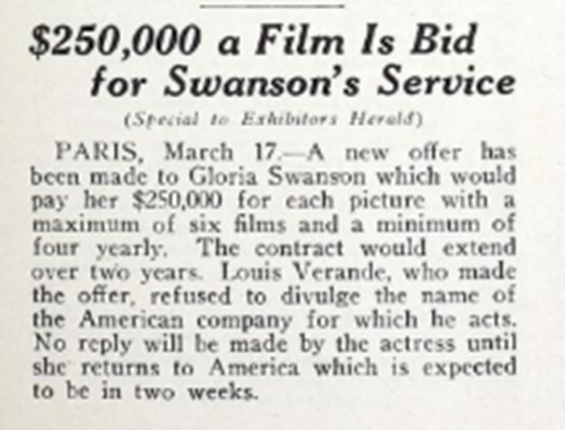
All of this personal turmoil left little time for talking business with Famous Players. That would have to wait. An item in the March 28, 1925 edition of “Exhibitors Herald” (carrying a March 17 dateline) seemed to make clear that Swanson’s contract options remained very much in play:
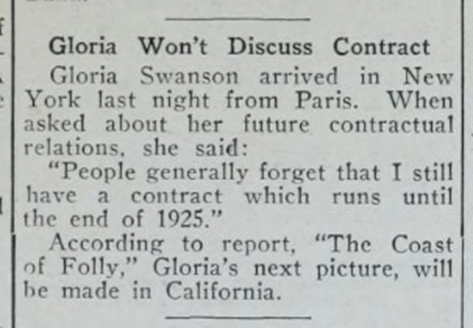
Swanson herself, to the extent that she was talking to the press at all, was playing the whole matter very close to the vest, as witness this item from the March 25 issue of “The Film Daily”:
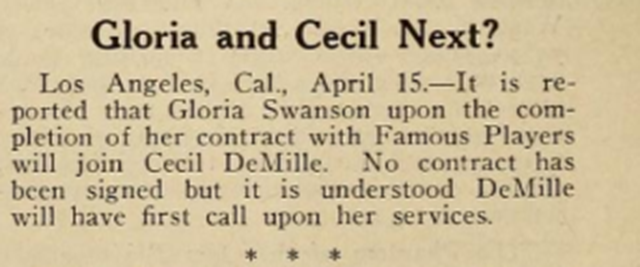
In the following weeks and months, the trade papers were rife with speculation about Swanson’s next contractual move. At one point, the rumor was that she would leave FP-L to join Cecil B. De Mille in his independent venture, the Producers Distributing Corporation. This was reported by “Exhibitors Trade Review” in its April 25 edition:
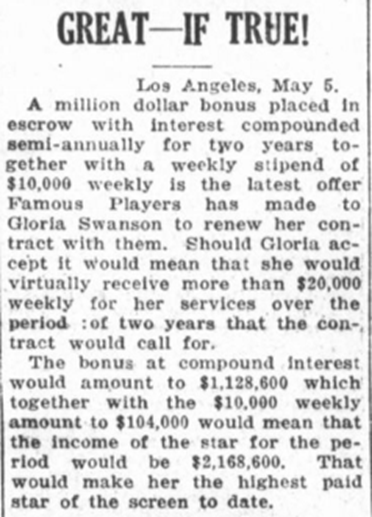
But then the May 6 edition of “Variety” reported that FP-L had raised its offer to an impressive level:
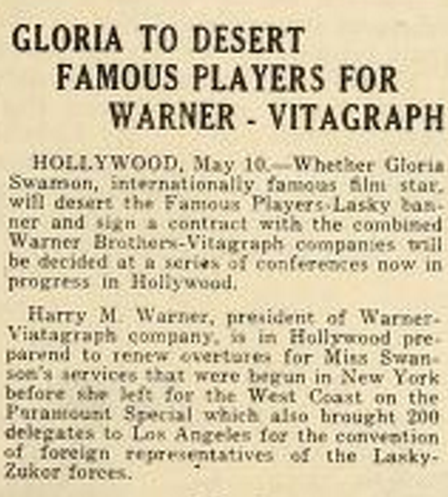
The May 23 edition of “Exhibitors Trade Review” subsequently indicated that Warner Brothers had entered the bidding war:
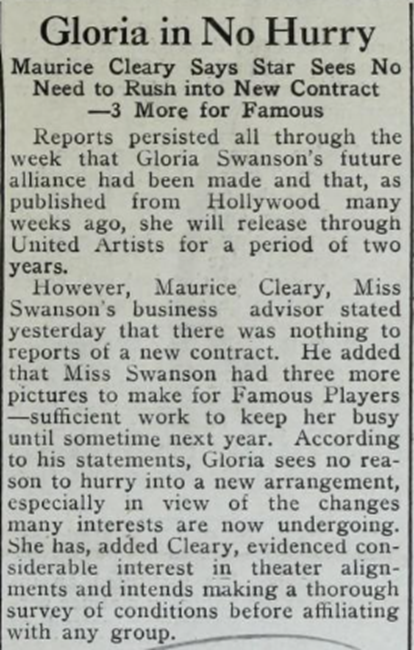
Swanson herself was content to allow the rumors to swirl, declining to confirm any reports. The August 21 edition of “The Film Daily” contained a denial of the latest rumor, which alleged that Swanson had made a distribution deal with United Artists:
But in fact Swanson was indeed contemplating an alliance with United Artists. The company, which had been founded in 1919 by Mary Pickford, Douglas Fairbanks, Charlie Chaplin, and D.W. Griffith, represented an opportunity for a top-tier star such as Swanson to become, in effect, an independent producer. Becoming a United Artists partner meant trading the security of a regular (and lucrative) paycheck from a major studio such as Famous Players for the right to direct one’s own career path as well as total creative freedom in the making of one’s films.
The partnership had worked out well for Pickford, Fairbanks, and Chaplin (Griffith had effectively dropped out early on), and Swanson was, in any case, ready for a change in her career path. She harbored a lingering resentment toward both Jesse Lasky at Famous Players and her old mentor, De Mille, due to their lack of support when she had been seeking to divorce her second husband, Herbert Somborn. If there was a viable way to free herself of their influence, she was ready to pursue it.
The October 14 edition of “Variety” carried a notice that appeared to confirm that the United Artists alliance was a done deal:
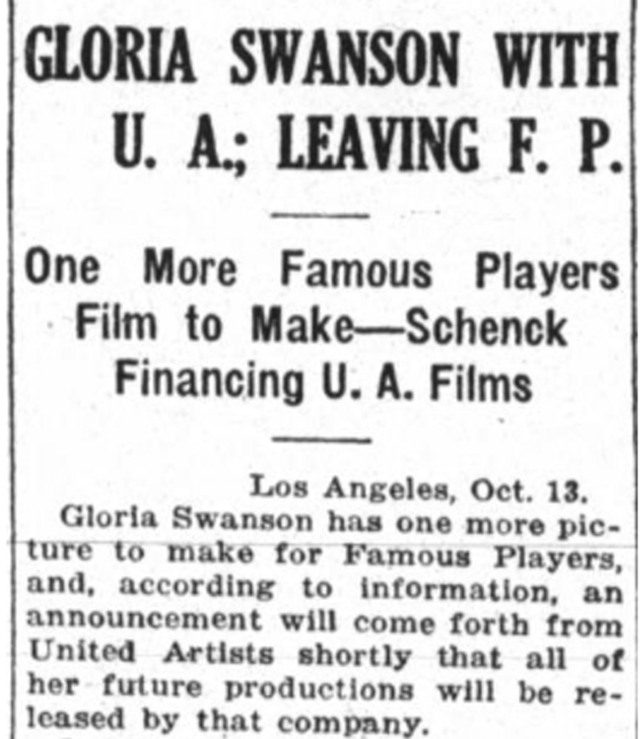
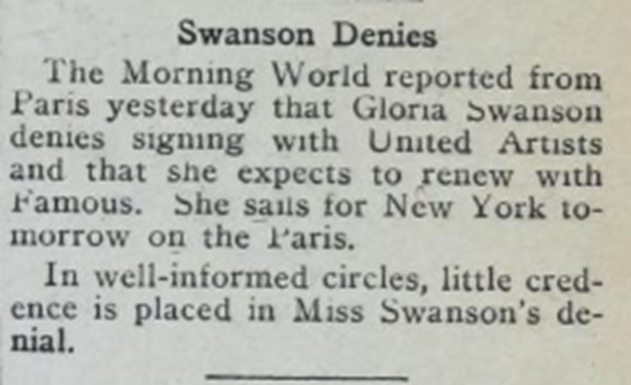
But Swanson was not yet ready to publicly confirm the reports, and in fact issued a denial, which was met with some skepticism in the industry, as reported in the October 27 edition of “The Film Daily”:
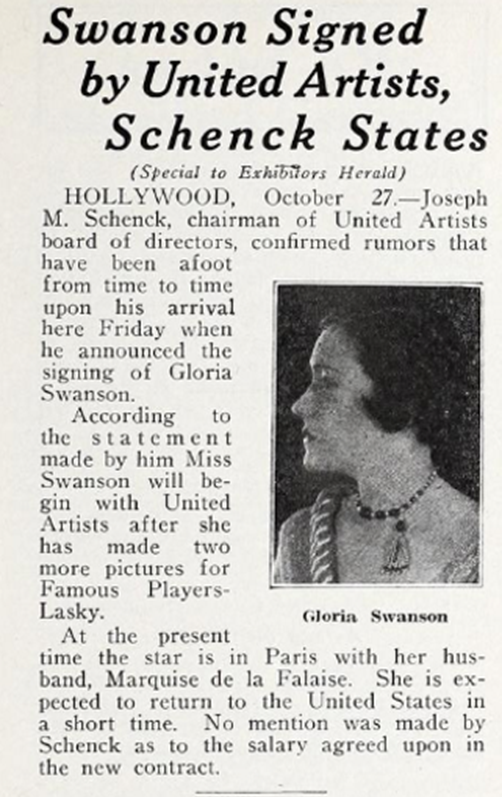
By early November, however, the cat was out of the bag. The November 7 issue of “Exhibitors Herald” reported that United Artists chairman Joseph Schenck had confirmed that Swanson had signed with the company:
Swanson was, at last, to be the captain of her own ship; the sole proprietor of her own career. All that remained of her career as a studio contract player was to finish out the films that she still owed to Famous Players. Following the 1926 Paramount release of FINE MANNERS, she was officially a free agent.
The “Los Angeles Illustrated Daily News” reported in its October 20, 1926 edition that Swanson had formed her own production company:
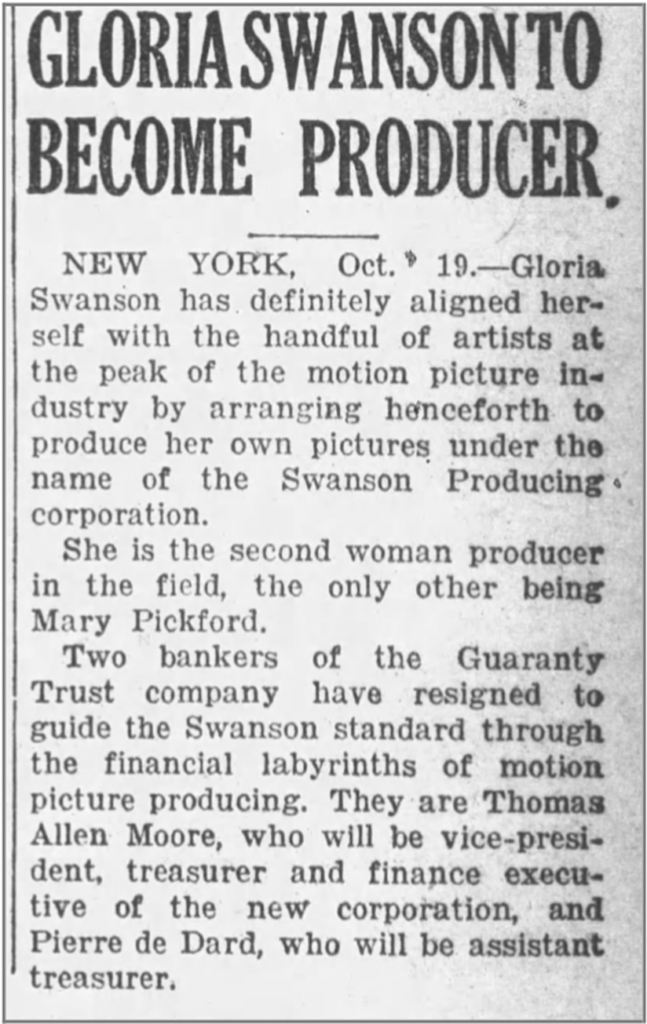
The reference to Pickford being the “only other” woman producer in the industry was, it should be noted, a contemporary observation, not a historical one. There had previously been a number of women who had their own production companies, including Alice Guy Blache, Gene Gauntier, and Lois Weber.
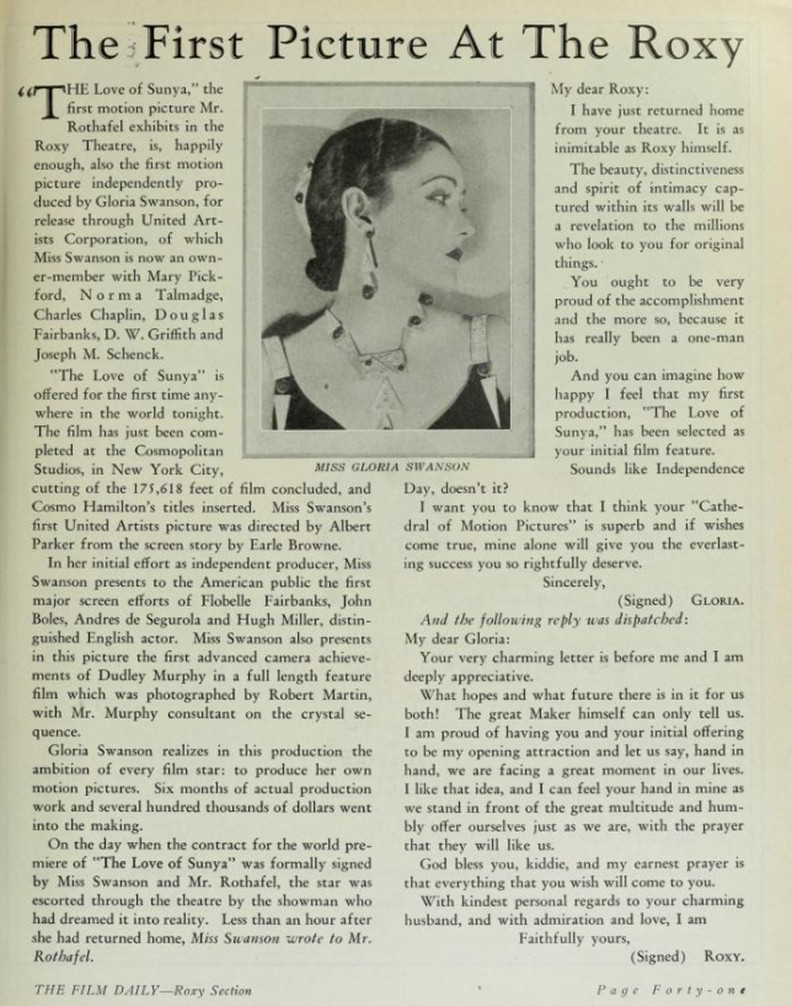
The months following Swanson’s launch of her independent production company would prove to be a harsh education in the rigors of being the boss. All executive decisions were now squarely on her shoulders, as was the responsibility for obtaining financing for her films. For her first independent film, she prudently opted for a proven property by remaking a 1919 picture, THE EYES OF YOUTH, that had been a success for Clara Kimball Young. Swanson’s remake, entitled THE LOVE OF SUNYA, has the distinction of having been the featured film at the opening night of the famous Roxy Theater in New York City. As such, it was the beneficiary of the publicity blitz that surrounded the theater’s debut, as in this full-page splash from the March 13, 1927 edition of “The Film Daily”:
The film was not a financial success, although it did (barely) recoup its production costs. Having gotten her feet wet as an independent producer with a relatively conservative choice of subject matter, Swanson decided to swing for the fences with her next project.
Somerset Maugham’s short story “Rain” had been adapted into a successful play in 1922, enjoying the kind of success that made it a natural property for subsequent adaptation into a film. The problem, however, was that the subject matter was far too risqué to be permitted under the prevailing content rules imposed by Will Hays at the MPPDA. Movies were, at that time, not subject to the protection of the First Amendment (per the Supreme Court’s ruling in Mutual Film v. Ohio Industrial Commission in 1915), so the constant threat of censorship required the Hays Office to keep a tight rein on any potentially censorable content. “Rain” was, therefore, a ripe, juicy plum that Hollywood was forbidden to pick.
Swanson, however, pulled a clever bait and switch by meeting with Hays and asking his permission to adapt a Somerset Maugham story called “Miss Thompson.” This was the title under which “Rain” had appeared in its original magazine publication. Hays, who was an admirer of Maugham, failed to make the connection between the forbidden play and the name of its lead character, and gave his blessing. Inevitably, a firestorm erupted in Hollywood when the studios who had been steering clear of the play learned that Swanson had obtained the rights, but Hays had given his word and he stuck to his promise.
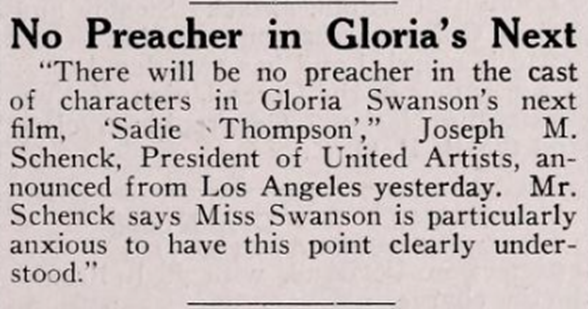
To soften the blow, Swanson pledged to modify somewhat the content of the story. Maugham’s short story involves the interaction between a prostitute named Sadie Thompson and a missionary who is determined to reform her, but who is ultimately seduced by her charms. The Hays code strictly forbade portraying a clergyman in a negative light, so Swanson announced that the character in question would be a self-righteous, fanatic reformer but not an actual clergyman. This was made clear in the June 3, 1927 edition of “Exhibitors Daily Review”:
The resulting picture, entitled SADIE THOMPSON, was a solid box office hit. Swanson’s sophomore effort as an independent producer had yielded the success that she needed to reassure her that the move away from being a studio contract player had not been a mistake.
More ordeals lay ahead of her, however. By this time, she had become involved, both professionally and personally, with Joseph Kennedy, the father of future president John Kennedy. Swanson allowed Kennedy to persuade her to take on an elaborate project for her next producing venture, and to hire as her director the redoubtable Erich von Stroheim. Although he was justly renowned as a brilliant director, Stroheim was equally notorious for his ungovernable extravagances. Schedules and budgets meant nothing to him, making him a gigantic pain for any producer to work with.
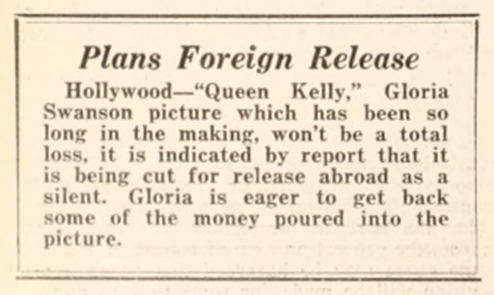
In the course of shooting the film, which was entitled QUEEN KELLY, Stroheim, predictably, ignored all constraints. He flouted budget limitations by spending freely, scorned common industry labor practices by working the crew punishingly long hours, and defied Hays Office content limitations by incorporating luridly repellant sexual content. In the end, Swanson and Kennedy had reached the limit of their patience, and Stroheim was fired from the project, leaving behind an unsalvageable mess. Ultimately, the film was deemed unreleasable and was shelved. Between its excessive length, its highly censorable content, and the fact that it had been shot as a silent film at a time when the talkie revolution was in full swing, there were just too many factors weighing against its commercial viability. A heavily truncated version did see a limited release in Europe, but the U.S. market was a dead loss. The September 27, 1930 edition of “Motion Picture News” noted the plans for the foreign release:
Swanson’s career survived the QUEEN KELLY debacle, but she had lost her taste for independent producing. Her company produced and released only two more titles before she shut down the company and ended her affiliation with United Artists by selling her stock back to them.
Returning to the ranks of studio contract players, Swanson’s career never again attained the heights of her glory days with De Mille and with Famous Players, but she nevertheless remained a star in the Hollywood firmament. Her most noteworthy role in the latter part of her career was undoubtedly that of Norma Desmond in Billy Wilder’s classic SUNSET BOULEVARD. Norma Desmond is a former star of silent movies whose career has faded, leaving her cast aside by the industry and largely forgotten. The parallel with Swanson’s own life was impossible to miss, although Swanson was never anywhere near as down-at-heel as Desmond. Still, Wilder pressed the parallels by casting Erich von Stroheim in the role of Desmond’s butler, who turns out to have been her former director (and ex-husband). The cherry on top was a scene in which Desmond is screening one of her own silent films in her living room. Naturally, Wilder used a clip from one of Swanson’s films for the scene. And the film from which the clip was taken was – what else? – QUEEN KELLY.
