
One century ago this week, “Moving Picture World” noted in its May 28, 1921 edition the acquisition of a cache of short films by business partners Leon Schlesinger and A.L. Feinman. In reporting the story, the trade paper uncharacteristically got one of the most salient details wrong.
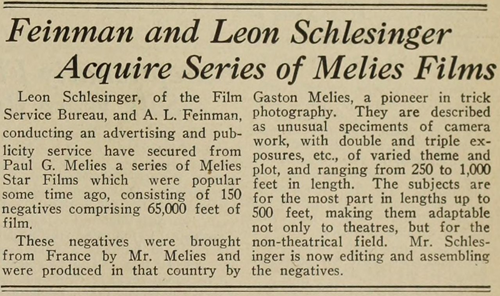
The story attributes the films in question to Gaston Melies, referring to him as “a pioneer in trick photography.” The films had actually been produced by Gaston’s brother, Georges Melies, who was the true visual effects pioneer in the family.
It’s not hard to account for the error. Around the turn of the twentieth century, illegal duplicate copies of the imaginative and visually exciting films being produced by Georges Melies were routinely finding their way to the United States, where they were presented to audiences by unscrupulous American studios who changed the titles and claimed the films as their own work. As copyright laws had not yet adequately caught up with the new medium of the cinema, the policing of pirated work was difficult at best, and all but impossible from across the Atlantic Ocean.
With that in mind, it seemed to make sense for Gaston to relocate to New York in 1902 and set up an American branch of Georges’s company “Melies Star Films” in order to facilitate distribution of the films in the U.S., and also to keep better tabs on the rampant piracy. Gaston’s trade paper ad from 1903 includes a stern warning to the film pirates.
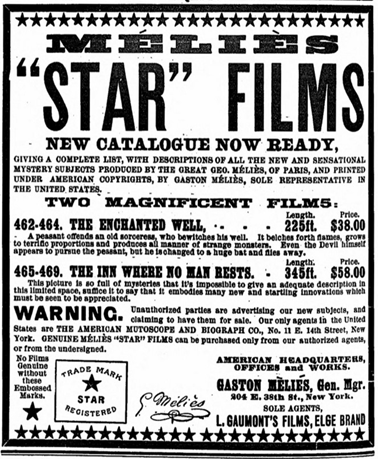
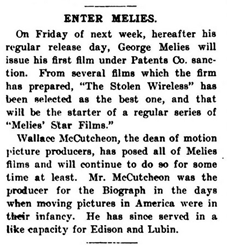
As the ad indicates, Gaston initially made a distribution deal with the Biograph Company. This made sense in that Biograph was a well-established U.S. company that was familiar with the market. Eventually, Biograph would become one of the founding members of Thomas Edison’s powerful Motion Picture Patents Company, and Melies Star Films would follow suit, throwing in with Edison as well. “Variety” carried the announcement in its October 9, 1909 edition:
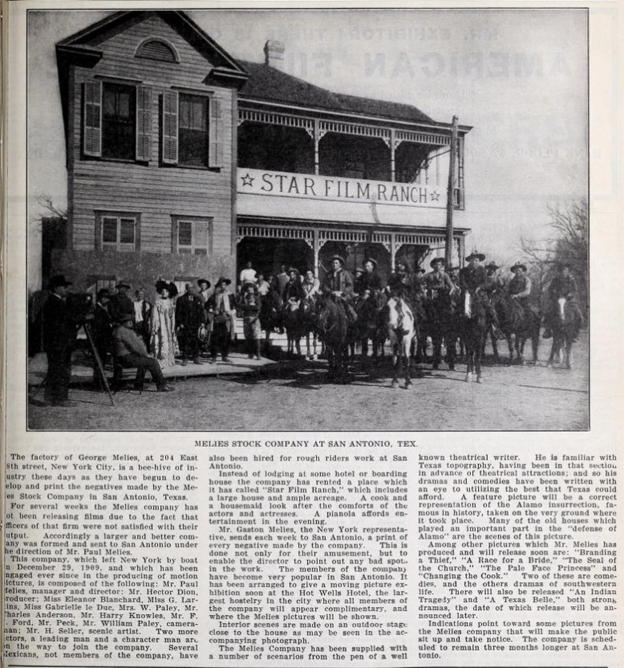
Becoming a Patents Company member entailed some significant advantages, but it came with certain obligations as well. Member companies were expected to release, at minimum, one film per week. Given the painstaking preparation required in order to create his striking visual effects, there was no way that Georges Melies could be expected to maintain that pace. Consequently, to ensure that the American Melies operation would be able to keep up with the demand for product, Gaston decided to become a producer himself. He set up his own studio facility and began cranking out Western movies – even going so far as to eventually move his production unit’s base of operations to San Antonio, Texas. In its February 26, 1910 edition, “The Film Index” ran a feature article depicting the Melies company setting up shop in San Antonio:
This, then, accounts for the error in the “Moving Picture World” article cited above, mistaking Gaston for Georges. By 1921, Gaston had long been a familiar name in the publication’s pages as a producer in his own right, so it was easy enough for an inattentive reporter to assume that an inventory of films with the name of Melies attached to them must surely be Gaston’s work. The fact that Gaston was known for producing Westerns while these films were notable for their fantasy stories and “trick photography” apparently suggested to the author of this article only that there were lesser known facets to Gaston’s cinematic repertoire. A bit of basic research would have disclosed the error in this assumption. The article implicitly acknowledges that the films in question were produced in France, so they could not have been Gaston’s work, as he had never made any films in France, only in the U.S.
The Paul Melies who is cited in the article as the immediate source of these films was Gaston’s son. Some years earlier, when the fortunes of the U.S. branch of Melies Star Film had begun to decline, Paul, acting for his father, had sold the company’s holdings, including films produced in France by Georges and distributed in the U.S. by Gaston, to the Vitagraph Company. This would seem to indicate that the cache of films acquired by Schlesinger and Feinman were separate from the holdings that Vitagraph had earlier acquired. Assuming that the article is correct that the prints had been brought by Paul from France, this would be significant, since it was only a couple of years later that Georges, bankrupt and despondent, would destroy every copy of his work that was in his possession, including negatives. Whatever Paul had been able to bring back to the U.S. to convey to Schlesinger and Feinman would therefore have otherwise been lost.
It was Schlesinger who ultimately hung on to these Melies acquisitions. Years later, he would also acquire the Vitagraph Melies holdings. Vitagraph had been bought in 1925 by Warner Brothers, who inherited the Melies inventory as part of that acquisition. And of course by that time, Schlesinger had a solid working relationship with Warners, for whom he was producing the very successful Looney Tunes and Merrie Melodies cartoons.
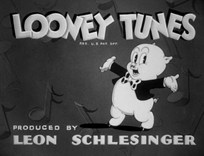
The Melies films must have seemed like worthless ancient relics to the Warner Brothers people, and if selling them off could keep the producer of a lucrative cartoon franchise happy, why not indulge him?
Interestingly, there are multiple sources that indicate that Schlesinger’s entire Melies collection was acquired from Warners in the 1930s, but the article above (which is supported by similar articles from that week in at least two other industry trade papers) seems to clearly indicate that Schlesinger had already bought into a Melies collection years before, and was merely enhancing it with his purchase from Warners.
It doesn’t appear that Schlesinger ever did very much to actively exploit his stockpile of Melies films, but above all he did preserve them. After his death in 1949, his widow donated his Melies collection to the Academy of Motion Picture Arts and Sciences, where they were preserved and archived. Duplicate prints were made before sending the original negatives to the Library of Congress.
Commercial rights to the films were purchased by a company called Blackhawk Films, which sold copies on the 8mm home movie market to film collectors.

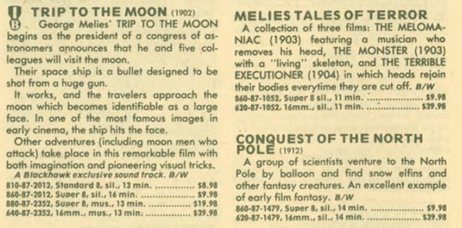
Thanks to Leon Schlesinger, these enchanting and groundbreaking films had not been left to decay in a forgotten Warner Brothers vault. Instead they were being projected onto home movie screens, still delighting viewers nearly a century after they were made.
Now, of course, we can enjoy the legacy of Georges Melies on blu-ray. But if Leon Schlesinger had not been a proven moneymaker for Warner Brothers, who knows whether they would have been willing to sell him those Melies titles? When we are enjoying the magic of Melies today, we should perhaps reflect that for the survival of at least some of the films we may well have Porky Pig to thank.
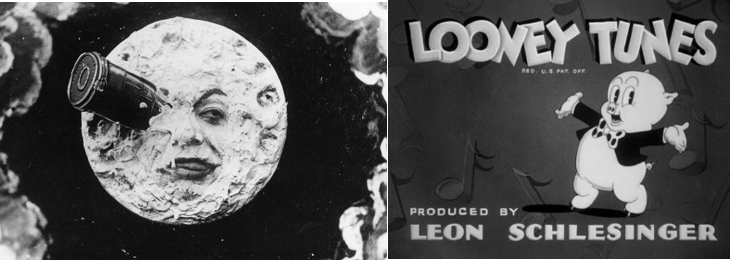

As a George Melies fan I find this fascinating.