
One century ago this week, the June 17, 1921 edition of “Variety” featured a page-one banner headline announcing “Zukor’s Big German Deal.”
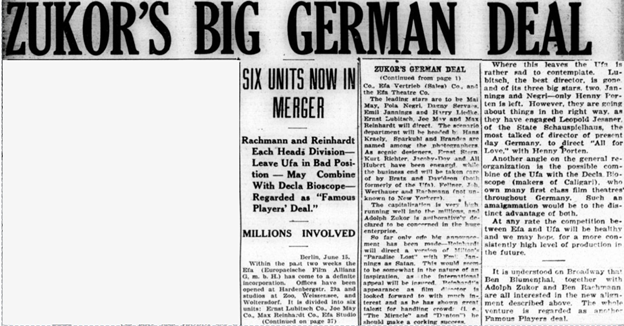
The Zukor in question was, of course, Adolph Zukor of Famous Players-Lasky, the pre-eminent movie tycoon of the period. The big deal being referenced was Zukor’s latest effort to extend the cinema hegemony of his company beyond the borders of the United States and into Germany. Zukor had already established dominance in the United States motion picture industry through a merger uniting a production company with a distribution company, followed by acquisition of a chain of theaters. This had the effect of consolidating the entire process, from manufacture of the product to retailing it to the public, under one corporate umbrella (so-called “vertical integration”). Now Zukor was seeking to expand his dominance on a global scale.
The German film industry had made a move into vertical integration even before Zukor. In 1917, the German government established a state-sponsored company as a way of enlisting the power of cinema in propping up the country’s propaganda effort during the World War. The government put up half of the funding while a consortium of businessmen put up the balance. Rather than start a new company from scratch, this new entity simply bought up a number of existing production companies. The new company was called Universum Film Aktiengesellschaft, which is a mouthful even for a native German, so the company was commonly referred to as “Ufa.” After the war, Ufa was a prime target for U.S. film companies because of the extremely favorable currency exchange rates. The postwar value of the German mark was in steep decline, so a German-made film could be acquired for release in the U.S. at bargain basement rates. An April 15, 1921 article in “Variety” summarized the situation succinctly:
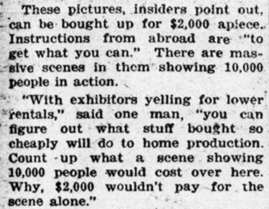
And the German product was not merely inexpensive – it was often of exceptional quality. To take just one example, THE CABINET OF DR. CALIGARI (which was not an Ufa production) had been released in the U.S. by Goldwyn and had garnered enthusiastic reviews owing to its strikingly expressionistic visual style.
However, not everyone was enthusiastic about German films, however aesthetically accomplished, turning up on American screens. The May 13th, 1921 edition of “Variety” had reported that a screening of CALIGARI in Los Angeles had been greeted with a barrage of rotten eggs:
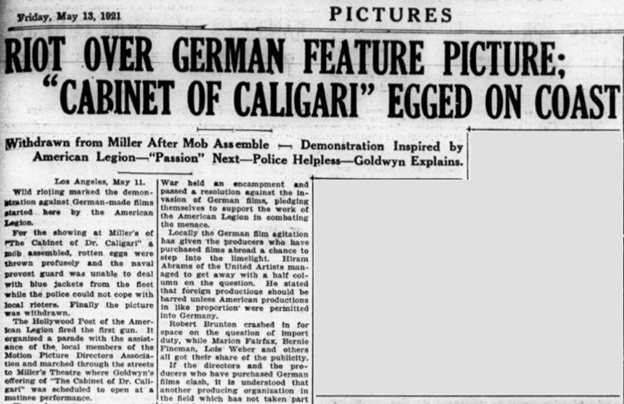
But even so, hard feelings about the war were one thing and business was another. And even though there was perhaps a legitimate business concern in that an influx of German films on U.S. screens might compete with the domestic product, there remained the tantalizing prospect of going beyond just importing German-made films by producing American-made films in Germany, paid for in dirt-cheap marks and then exported to earn dollars back home.
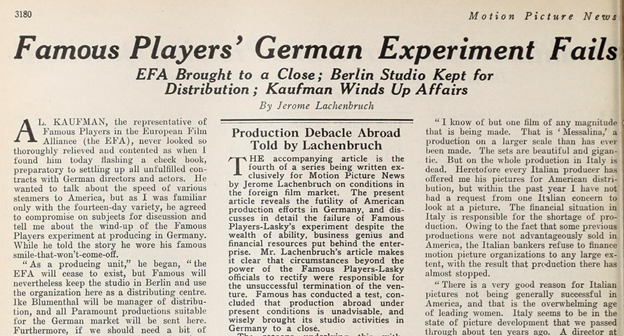
By setting up the European Film Alliance, as noted in the article above, Zukor accomplished the dual goals of establishing a production presence in Germany and staging what amounted to a wholesale talent raid on Ufa, successfully luring away such marketable names as Pola Negri and Emil Jannings. The E.F.A., however, was not destined to survive long-term. It would be dissolved in late 1922, as noted in this article from the December 23, 1922 edition of “Motion Picture News.”:
But Hollywood, and Zukor in particular, was not yet done with making incursions into the German market. Later in 1921, Ufa’s stockholders had approved a merger with the Decla Bioscop studio (where CALIGARI had been made) and the deal was finalized by mid-1922. This acquisition had helped Ufa weather the massive loss of talent from the E.F.A. deal for a time. But by 1925, Ufa was again in financial trouble.
This time it was Carl Laemmle at Universal who sought to capitalize on Ufa’s economic downturn by extending a financing offer to them. In fact, by December he was confident that he had the deal all sewn up, as “Moving Picture World” reported in its December 5, 1925 edition:
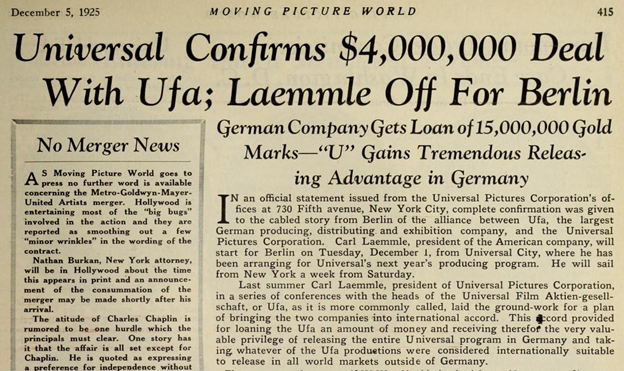
Zukor, for his part, was undeterred by the news of Laemmle’s apparent coup. He was not about to miss out on this opportunity. Making common cause with MGM, who also didn’t want to see Laemmle walk away with all the marbles, Zukor dispatched representatives from both studios to Berlin. Whereas Laemmle, blissfully unaware of any necessity for urgency, took a leisurely train trip to Berlin, the Famous Players – MGM delegation traveled by airplane from London to get there first. And although a deal had indeed been closed with Laemmle, this Zukor-backed group used their considerable market leverage to induce Ufa to reconsider their agreement with Universal. As Vito Corleone would put it, they made them an offer they couldn’t refuse. Some time later, when Laemmle arrived in Berlin to claim his prize, he found himself unexpectedly empty-handed.
“Variety” reported Laemmle’s change of fortune in its December 30, 1925 edition, noting that Laemmle “seems to be out in the cold.”:
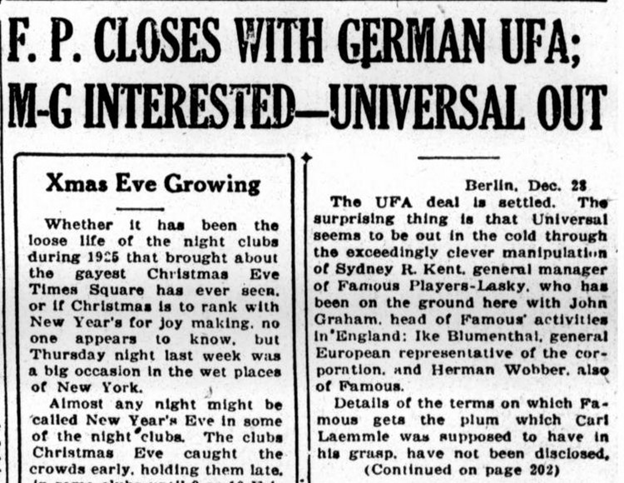
The deal that emerged from this negotiation was not, to say the least, an advantageous one for Ufa. Indeed, by the time the Ufa delegation stood up from the negotiating table, the gentlemen from Hollywood had eaten their lunch and rolled them for their pocket change. The deal was, at bottom, about Hollywood gaining access to the German theaters controlled by Ufa. A new distribution company was formed, taking its name from the names of the three principles: Parufamet. “Par” was from Paramount (Famous Players – Lasky’s distribution company, which would eventually lend its name to the company as a whole), and “met” was from Metro, with Ufa sandwiched in between – the inelegant name thus represents a triumph of corporate vanity over euphony.
Under the terms of the deal, Hollywood films, particularly those of Famous Players and MGM, were guaranteed substantial play dates in Ufa’s theaters. There was language in the agreement about Ufa films getting screenings in American theaters, but it was vague language, and it would be largely ignored in practice. Typical of the complaints that Ufa would subsequently raise, and of Zukor’s noncommittal responses to them, is this “New York Times” article of May 2, 1927:

By 1928, Ufa would reach the point of simply giving up on reaping significant benefits from Parufamet, and would withdraw their films from the distributor altogether, leaving it as just a pure conduit for Hollywood films to German screens. Soon thereafter, the arrival of talking films would shake things up sufficiently for Parufamet to be scrapped altogether.
But by that time all the major Hollywood studios had established their own distribution outlets in Berlin in any case. Parufamet would not be missed; not by Hollywood, and certainly not by the German film industry, for whom it had been little more than a scaled-down recapitulation of the Treaty of Versailles.
