

One century ago this week, the June 23, 1923 edition of “Exhibitors Herald” carried this notice:
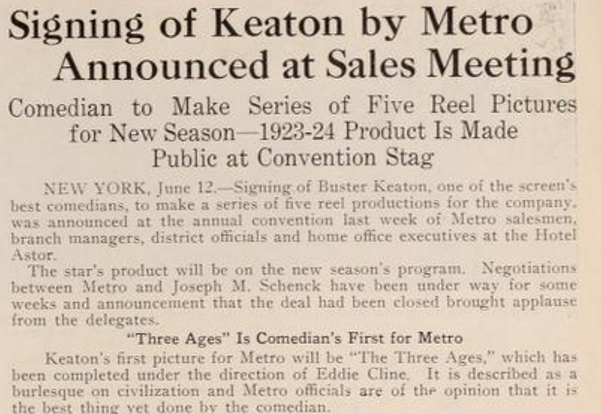
This marked Buster Keaton’s return to the Metro fold after an interim period during which he had been releasing his films through another distributor. His first stint with Metro had been announced in the April 17, 1920 edition of “Exhibitors Herald”:
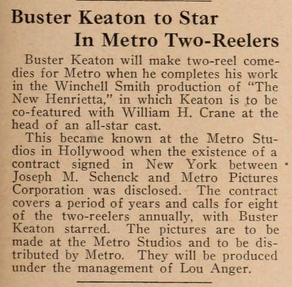
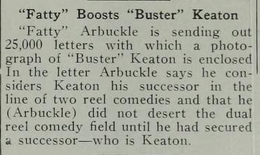
This move into starring roles in two-reel comedies was, in effect, a promotion. Prior to that he had been a supporting player in two-reelers starring Roscoe Arbuckle, who had become his friend and mentor. Indeed, when Arbuckle made the move into feature length productions, he enthusiastically supported Keaton as his successor in the “Comique” studio short comedies, as reported in the October 2, 1920 edition of “Wid’s Daily”:
However, although Arbuckle was a guiding force in Keaton’s early film career, it was producer Joseph Schenck who managed the business enterprise that employed both Keaton and Arbuckle. Schenck and his brother, Nicholas, had gotten into the movie business early on by way of other facets of the amusement business. Notably, the brothers had purchased New Jersey’s Palisades amusement park in 1910 and developed it into a major attraction. But the Schenck brothers also went to work for theater entrepreneur Marcus Loew. Both brothers thrived in the Loew organization, with Joseph eventually rising to the position of general manager of Loew’s booking agency, as noted in the trade paper ad reproduced below.
Then, in 1916, Schenck married movie actress Norma Talmadge, as noted in the November 3, 1916 edition of “Variety”:
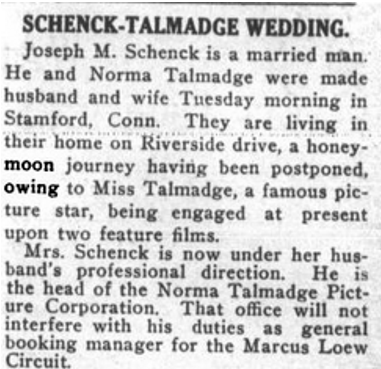
To further his new bride’s career Schenck had formed the Norma Talmadge Picture Corporation so that he could maintain executive control over the pictures in which she would appear and could secure appropriate distribution for them. Although the “Variety” article indicates that this would not interfere with his duties for Loew, in fact he did end up leaving the Loew organization in 1917. Nicholas, on the other hand, remained with Loew, and by 1919 would be named vice president and general manager of Loew’s Inc.
When Keaton replaced Arbuckle as Joseph Schenck’s primary two-reel comedy star, Schenck set up a company bearing Keaton’s name, much as he had done for Norma Talmadge. But Keaton’s affiliation with Schenck soon became something more than just a business relationship. In February of 1921, Keaton married Natalie Talmadge, Norma’s sister, as reported in the February 11, 1921 edition of “Variety”:
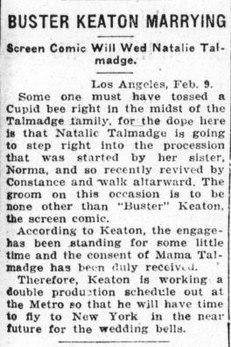
Keaton and Schenck were now in-laws. This must have been reassuring to Keaton. After all, he had grown up performing on the vaudeville stage with his parents as “The Three Keatons,” so for him show business and family had always been intimately interwoven. Being related to the man who was overseeing his career, even if only by marriage, would undoubtedly have felt familiar and comfortable. The result was that Keaton trusted Schenck.
It was useful to Keaton to have someone he trusted handling the business end of his career because unlike, say, Charles Chaplin, Keaton was not an astute businessman. As a filmmaker and comic he was a transcendent genius, but in the realm of contract negotiations and asset management he was a naif. With Schenck firmly in charge of those matters, Keaton was free to devote all his energies to the creation of his cinematic masterworks.
In general, Schenck was a good steward of Keaton’s business interests. When Keaton’s initial deal with Metro for two-reel pictures expired, Schenck was able to obtain better terms for his later two-reelers from First National, as noted in the May 21, 1921 edition of “Exhibitors Herald”:
But as the First National deal neared its expiration and Keaton was ready to move into feature length comedies the more advantageous move was the 1923 return to Metro, as noted above. Moreover, Metro was owned by Loew, Inc., which meant that Joseph’s brother Nicholas would be a party to the deal, further extending the familial ties that Keaton valued.
But Schenck’s own career trajectory was undergoing an evolution. Increasingly he would move away from being an independent producer and toward being an upper-level management executive at the major studio level. In late 1924 Schenck joined United Artists as a partner and chairman of the board, as reported in the November 15 edition of “Exhibitors Herald”:
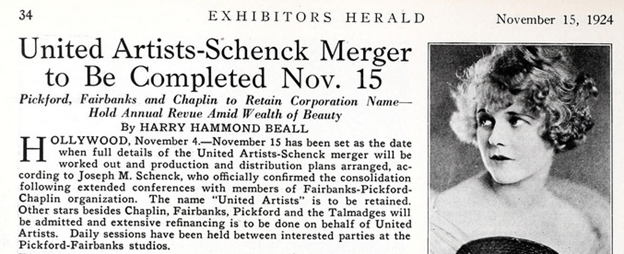
Eventually Schenck would go on to partner with Darryl Zanuck to create Twentieth Century Pictures, which in turn would merge with Fox to become yet another major studio.
Understandably, over time Schenck’s ambitions as an independent producer were eclipsed by his ambitions as a studio executive. So it was perhaps inevitable that the time would come when his prior business relationship with Keaton would come to an end.
The beginning of Keaton’s split with Schenck can be found in this article from the November 6, 1926 edition of “Exhibitors Herald”:
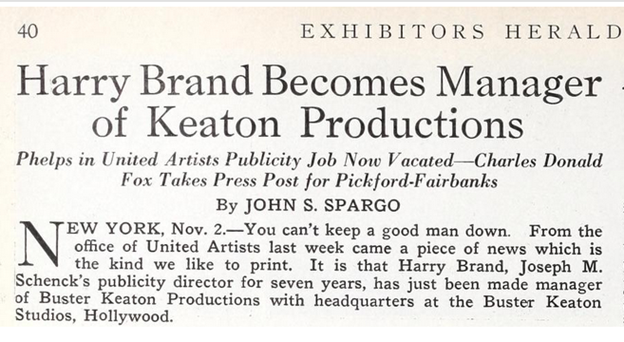
Harry Brand and Keaton had always gotten along quite well, so Brand’s elevation to management of the Keaton company was not in itself problematic. But when Keaton’s film COLLEGE premiered, he was taken aback to see Brand given a prominent screen credit as “supervisor” of the film:
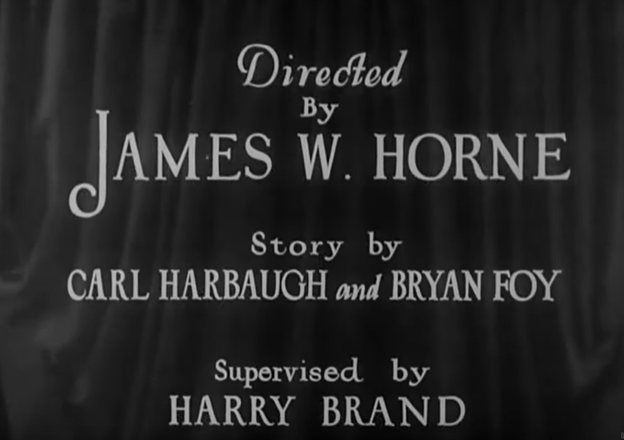
In Keaton’s mind, business management was one thing and creative input into the making of the films was quite another. He was not prepared to stand for Brand being given that kind of authority. Schenck himself had never sought to exercise that kind of control; his credits on the films always read “Presented by Joseph M. Schenck,” never “supervised by.” Keaton resented the imposition of a bean-counter as a supervisor over the creative process, and he said so to Schenck in no uncertain terms.
To Keaton’s very real shock, however, Schenck’s response was that the point was moot because he intended to shut down the Buster Keaton Productions company altogether. For the first time, Keaton faced the prospect of becoming the sole proprietor of his own career. This left Keaton with a decision to make. He could form his own company and produce his own films, as his industry peer Chaplin had done, or he could look around for another company to work for. This would inevitably mean going to work for one of the major studios, since the growth of the industry in recent years meant that smaller independent producers, of the sort that Schenck had been, were becoming distinctly thin on the ground.
Schenck’s advice to Keaton at this crucial juncture was to go with the company that Metro had been merged into – Metro-Goldwyn-Mayer. After all, Nicholas Schenck was a top executive there, and could be expected to take care of Keaton just as his brother Joseph had done. It was a way for Keaton to maintain the feeling of family ties that had been so important to him all along. Chaplin and Harold Lloyd both advised Keaton against making the move to MGM. They knew that his creative autonomy would be compromised in the procrustean bed of MGM’s top-down regimentation, and that the quality of his films would suffer accordingly.
Keaton considered their advice, but ultimately decided to be guided by Schenck. His move to MGM was noted in the October 12, 1927 edition of “Variety”:
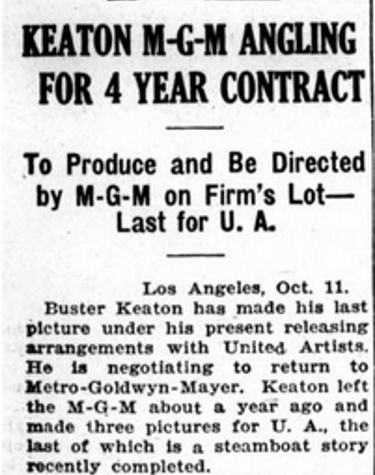
Sadly, the predictions of Keaton’s fellow comic stars proved all too accurate. Nicholas Schenck was not the sort of nurturing father figure that Joseph Schenck had been. Keaton was able to make one film at MGM – THE CAMERAMAN – that bears comparison to his best work under Joseph Schenck, and one more film – SPITE MARRIAGE – that, while a lesser work, is still recognizably Keatonesque. But thereafter he was forced into a creatively crippling mold by MGM supervisors who had no understanding of the kind of material in which he could shine. The final blow was the tone-deaf decision to pair him with Jimmy Durante in a series of films. Both Keaton and Durante were individually funny, but as a comic duo they were oil and water.
Keaton’s return to Metro in June of 1923 had marked the beginning of his most creatively fertile period, including his classic feature films OUR HOSPITALITY, SHERLOCK JR., and THE NAVIGATOR. But this was not the same Metro that had distributed his early two-reelers. This was a Loew-owned Metro that was already angling to expand its production footprint in the industry and would soon acquire the Goldwyn company to form Metro-Goldwyn, ultimately to become Metro-Goldwyn-Mayer. Joseph Schenck had briefly switched the distribution of Keaton’s films to United Artists (for obvious reasons) during the pinnacle of Keaton’s run of masterworks, the period that saw the release of STEAMBOAT BILL JR. and THE GENERAL. But in urging Keaton to return to the MGM fold, Schenck was delivering him into the purgatory of a corporate monolith where the notion that he was the best judge of how to utilize his talents was anathema.
When Metro was absorbed into the corporate leviathan called Metro-Goldwyn-Mayer, a new business ethos was imposed in which the creative intuition of talented individuals was subordinated to an authoritarian chain of command. There were artists who were able to thrive in this environment, but Keaton was not one of them. The interplay between the subtlety of his pantomime and the Swiss-watch timing of his knockabout stunts was as delicate and fragile as a soap bubble; it could not survive the laying on of coarse hands from the front office. If Keaton had been able to resist the memory of his earlier successes with the old Metro and the siren call of the family ties represented by the Schenck name, if he had been persuaded by the savvy advice of Chaplin and Lloyd, we can only guess at how many additional classic works he might have created.
