

One century ago this week, the January 23, 1926 edition of “Motion Picture News” reported that Max Fleischer had assumed the role of president of Red Seal Pictures Corporation:
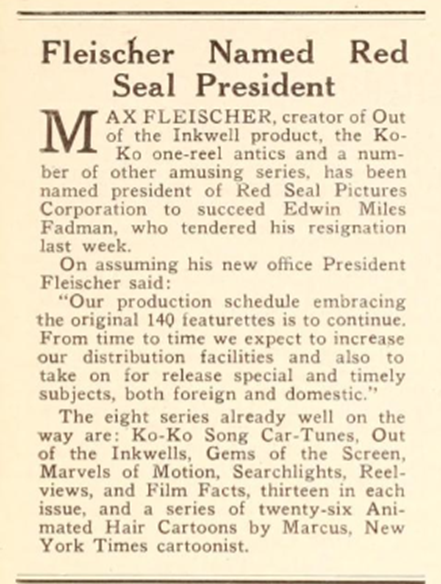
Fleischer’s move into this new role was, in effect, an attempted rescue action undertaken in hopes of propping up a failing enterprise.
An inventive and pioneering animator, Fleischer’s first break in the industry had been a partnership with J.R. Bray, who was under contract to provide short subjects for Paramount. For Bray’s company, Fleischer produced an innovative series of cartoons under the general title “Out of the Inkwell.” In a clever literalization of this title, Fleischer depicted a clown character actually emerging from his ink pen to take shape and interact with the artist. (The clown figure would later acquire the name “Ko-Ko,” and would become one of Fleischer’s most successful animated characters.)
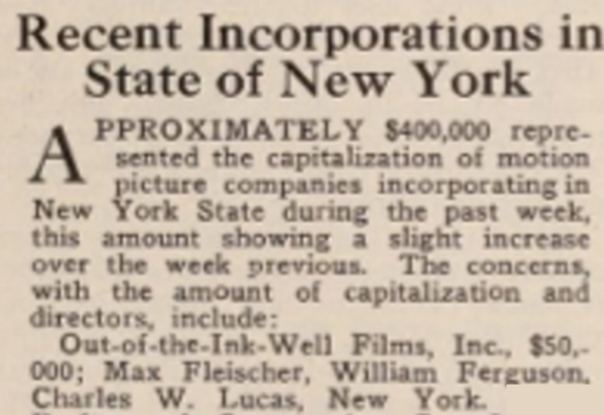
By 1921, Fleischer left Bray to form an independent production company, called, unsurprisingly, “Out of the Inkwell, Inc.” The November 5, 1921 edition of “Motion Picture News” included the Fleischer venture in its listing of recent New York incorporations:
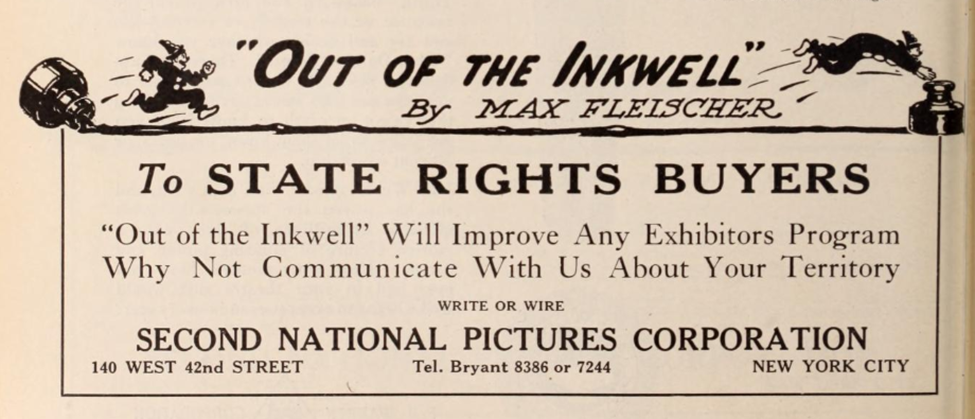
The new company initially made a deal with Second National Pictures to distribute their product, as shown in this 1921 trade paper ad:
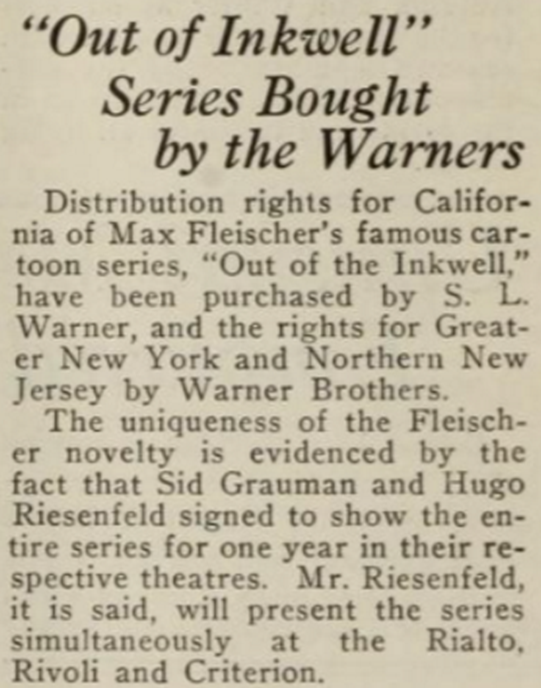
But very quickly the success of their cartoons attracted the interest of Warner Brothers, as reported in the December 17, 1921 edition of “Moving Picture World”:
Harry Warner assigned management of the Inkwell product to his secretary, Margaret Winkler, whose business acumen had impressed him. Warner’s assessment of Winkler’s abilities proved to be remarkably astute; so much so that she would soon leave Warner’s to go into business for herself, as noted in the February 25, 1922 edition of “Motion Picture News”:
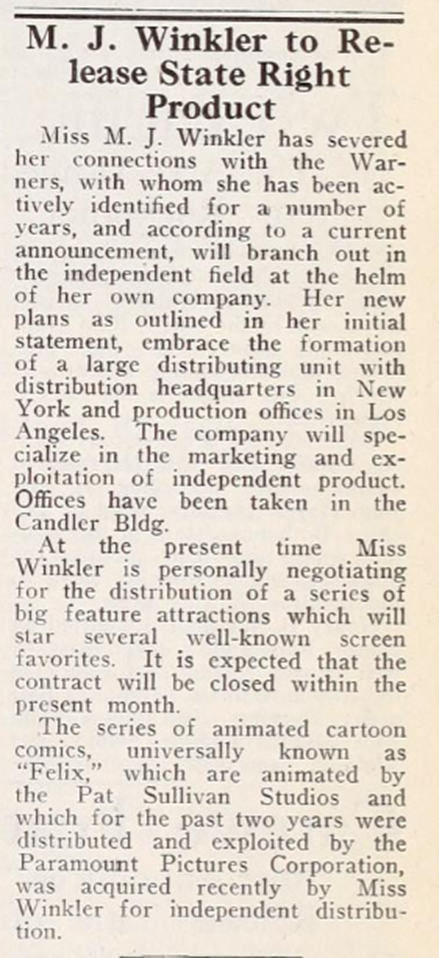
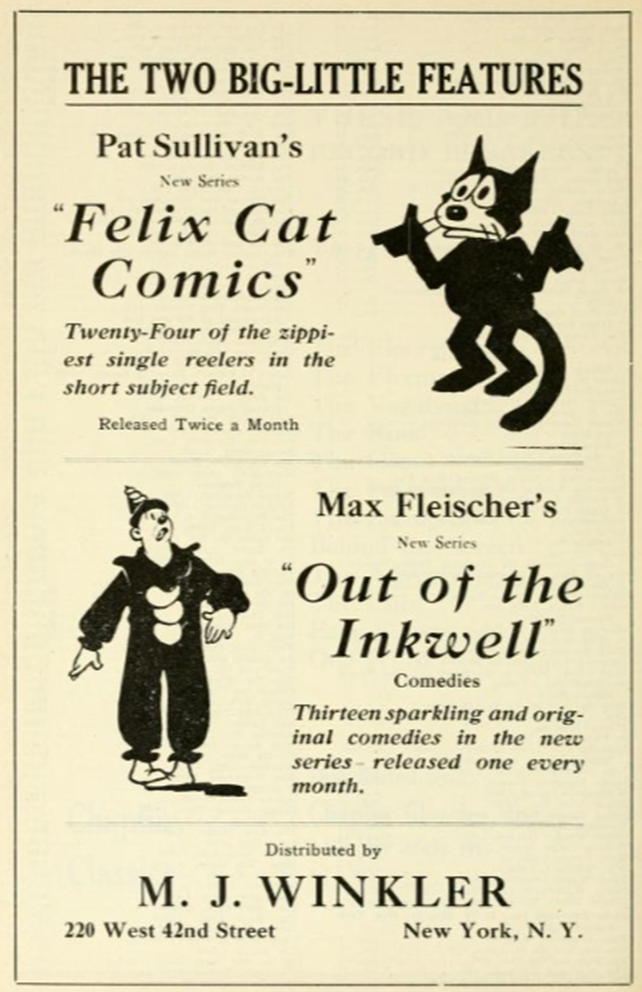
This was a remarkable development. Although women had played prominent roles in the early years of the film industry, by 1922 Hollywood had largely become the boys’ club it would remain for the next several decades. Female executives were thin on the ground at that point, but Winkler was a notable exception. In fact, to conceal her gender, Winkler used only her initials in her company name. Winkler’s new venture did not interrupt her relationship with Fleischer and Out of the Inkwell. Fleischer opted to leave Warner’s and go with Winkler, who had made a success in promoting the “Felix the Cat” series of Pat Sullivan. In this ad from “Wid’s 1922-23 Film Yearbook,” she yoked the Fleischer product to the Sullivan product, allowing them to reinforce each other’s prestige in the marketplace rather than presenting them as competitors.:
(Winkler would also be instrumental in furthering the career of another struggling animator named Walter Elias Disney, but that’s another story.)
Following her marriage to Charles Mintz in November of 1923, Winkler opted to withdraw from the business world. Although the M.J. Winkler company continued under the management of Winkler’s husband, Fleischer decided to leave Winkler and set up his own independent distribution company. The new enterprise was called Red Seal Pictures.
In forming Red Seal, Fleischer partnered with Edwin Fadman and Harold Rodner, as noted in the November 10, 1923 edition of “Motion Picture News”:
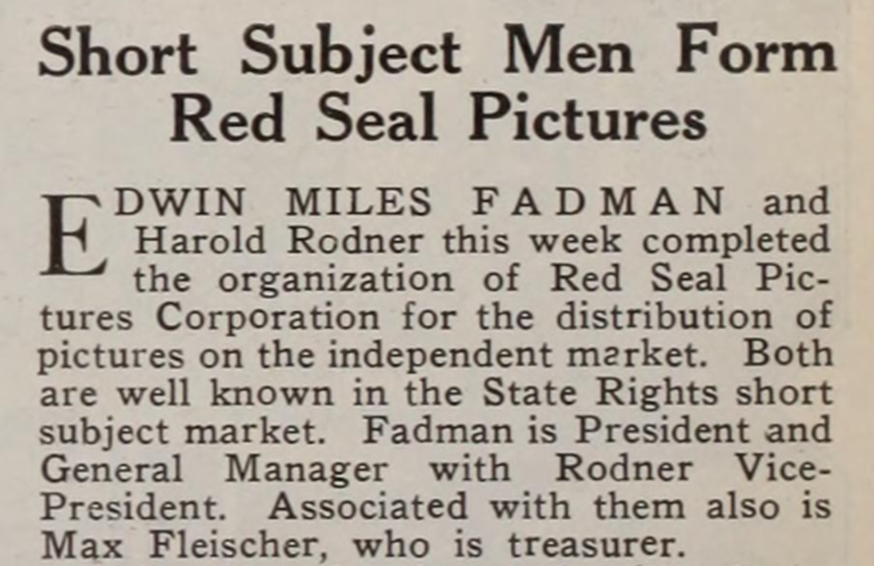
Under Fadman’s leadership, Red Seal embarked on an ambitious slate of releases. In addition to Fleischer’s popular Ko-Ko cartoons, the company produced sing-along cartoons, updating a familiar theatrical practice. During reel changes, exhibitors would often put up a slide on the screen with the lyrics to a popular song, inviting the audience to sing along with it. But all too often the audience would lose their place in the melody, failing to maintain a consistent rhythm and falling out of unison. Fleischer’s solution was to make the sing-along a movie, not a slide, and to include with the lyrics on the screen a bouncing ball above the words that would bounce onto each syllable as it was to be sung, thereby acting as an animated conductor of sorts for the singing. Audiences loved these “Car-tunes,” as they were called, and the phrase “follow the bouncing ball” soon entered the language as a common catch phrase.
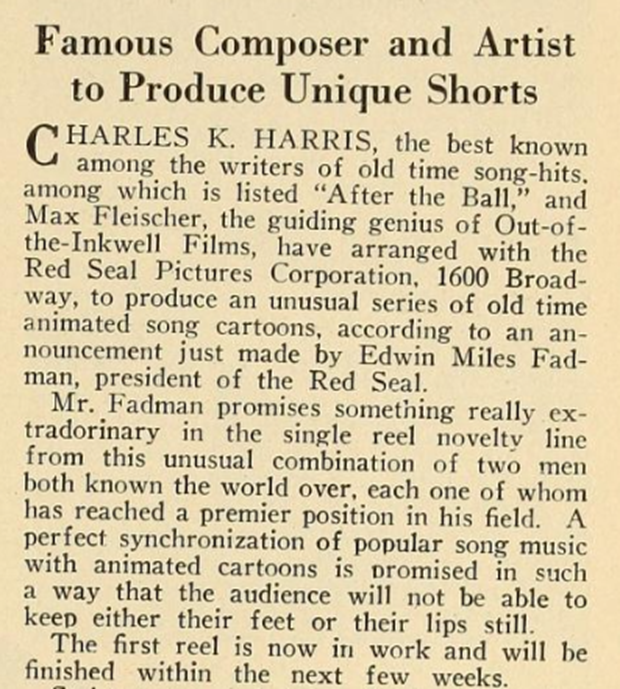
To launch the “car-tunes,” Red Seal partnered with song composer Charles Harris, as reported in the February 2, 1924 edition of “Exhibitors Trade Review”:
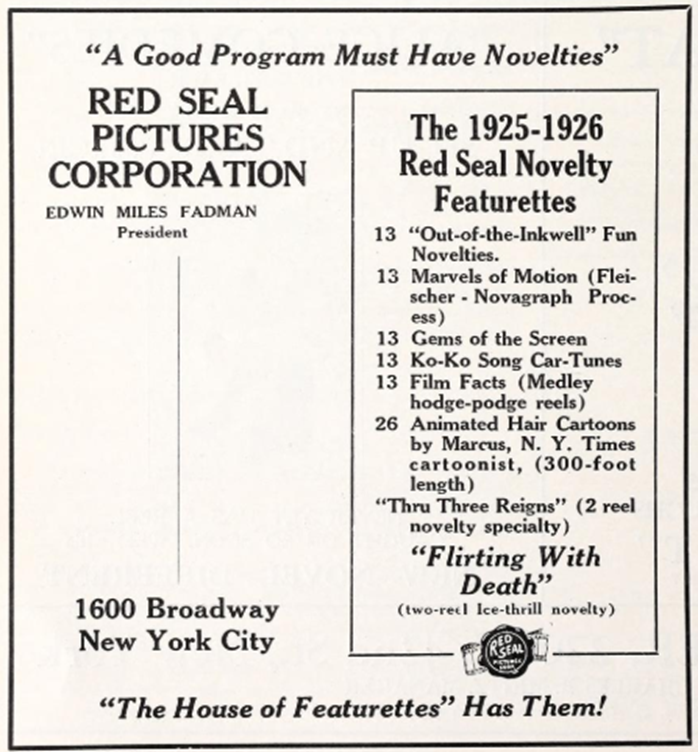
Unfortunately, the slate of productions undertaken by Red Seal ultimately proved to be rather too ambitious. They expanded beyond animation to produce live action short subjects, offering a broad roster of “novelties,” as shown in this 1925 trade paper ad:
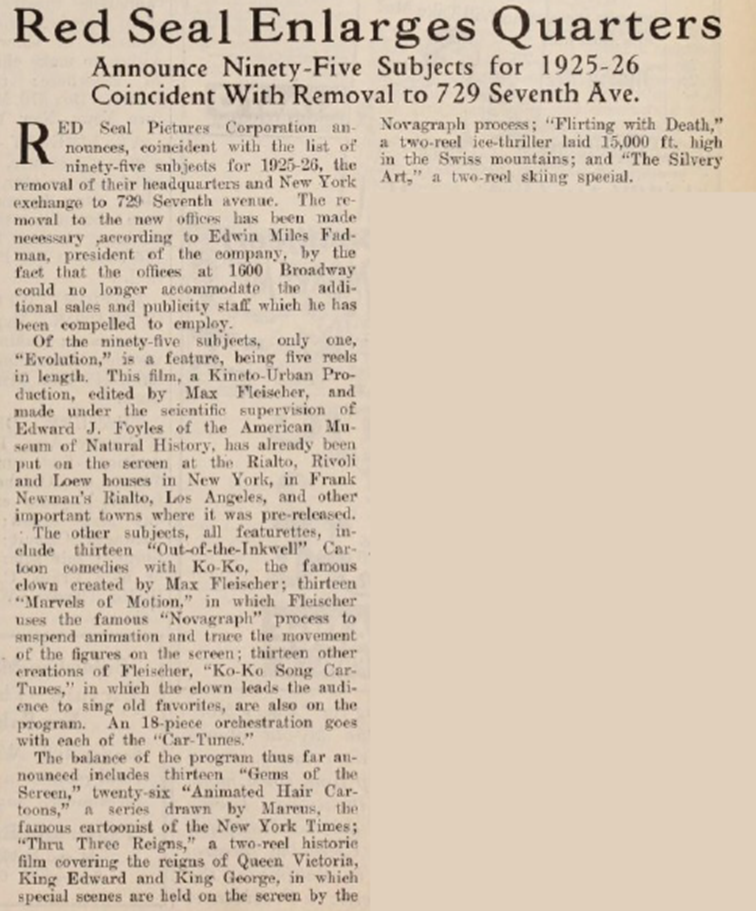
Fadman optimistically moved the enterprise to larger quarters while announcing no less than 95 new releases for the coming year, as reported in the August 29, 1925 edition of “Motion Picture News”:
There was no way for Red Seal to produce this quantity of material in-house, so they began purchasing films made by other independent production companies and releasing them under the Red Seal banner. However, too many of these were of lesser quality and did not perform well enough in the marketplace to justify their cost. The end result was that Red Seal found itself unable to pay its bills.
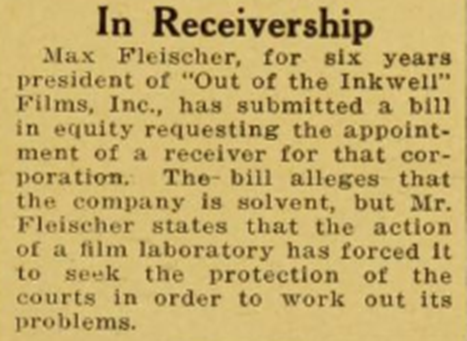
Fadman’s subsequent resignation from the company was what prompted Fleischer to take the step of assuming the presidency in January of 1926, as cited in the article above. He did his best to make a go of it, but by October of 1926 the financial situation reached a critical point when the lab that processed their film stock refused to release the most recent batch of developed negatives until the outstanding balance was paid, bringing production to a halt. The October 16, 1926 edition of “Moving Picture World” reported that Out of the Inkwell Films was in receivership:
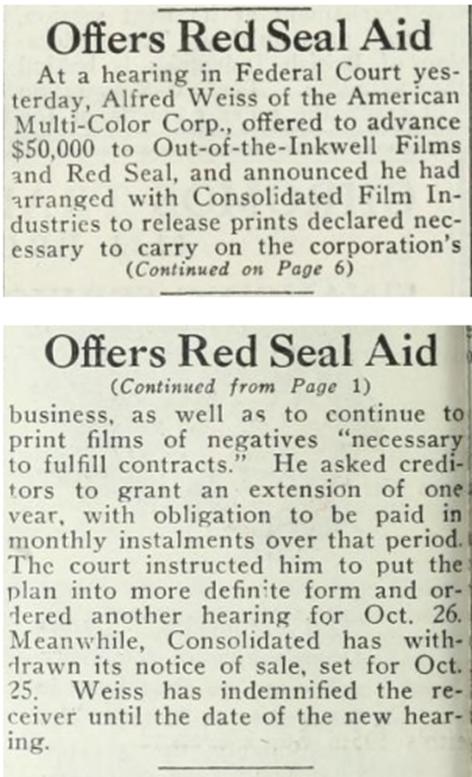
That might well have been the end for Red Seal, and it might have taken Out of the Inkwell down with it, but, at the last minute, salvation for the enterprise appeared in the person of Alfred Weiss, as reported in the October 20, 1926 edition of “The Film Daily”:
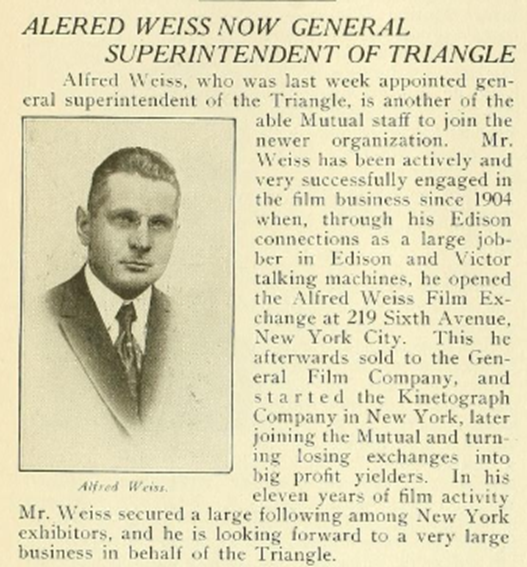
Weiss was an old hand in the Hollywood industry, having been a founding participant in the Triangle Film Corporation, which had been formed back in 1915 to handle distribution of the films of the powerhouse trio of D.W. Griffith, Thomas Ince, and Mack Sennett. Even then he had a long pedigree in the industry, as this announcement from the September 4, 1915 edition of “Motography” outlines:
It seemed initially that Weiss was just the tonic that the flagging company needed to get back on track. Unfortunately, he took his new leadership position as a license to begin making unnecessary and in some cases counterproductive changes. “Out of the Inkwell” was by this time a well-established brand name, but Weiss chose to substitute the name “Inkwell Imps,” while giving himself a prominent “Alfred Weiss Presents” credit above the titles of the releases, as shown below:

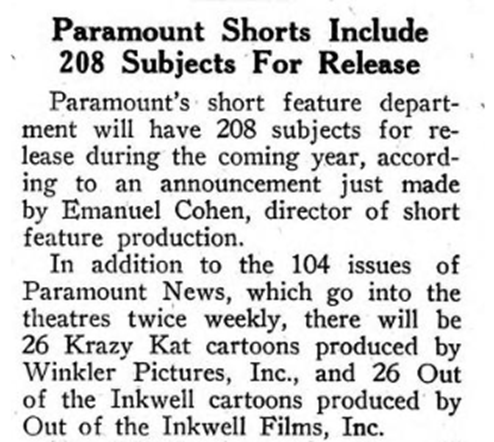
Weiss also abandoned the idea of using Red Seal to distribute the Fleischer product, opting instead to make a distribution deal with Paramount. An article in the April 23, 1927 edition of “Canadian Moving Picture Digest” notes the inclusion of Inkwell releases among the upcoming Paramount slate:
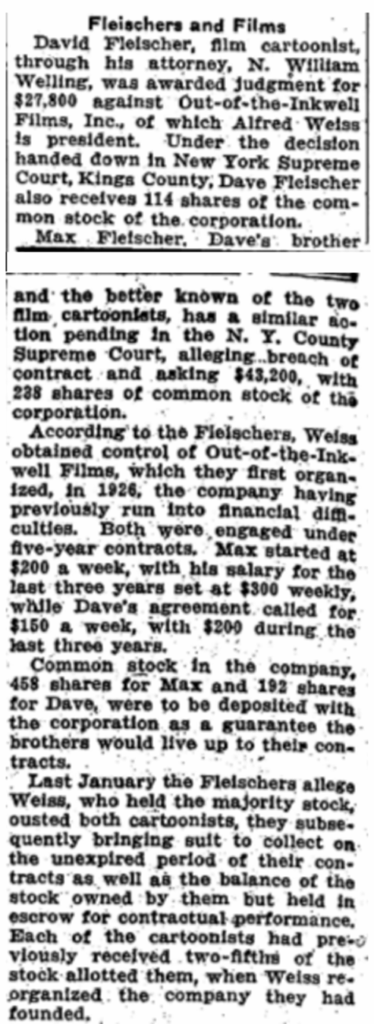
Friction between Weiss and both Max Fleischer and his brother and partner Dave Fleischer eventually led to an acrimonious parting of the ways. The Fleischers ended up leaving behind both the company they had founded and the “Out of the Inkwell” brand that they had labored to build into a successful commodity. This was followed by a legal action by the Fleischers against Weiss and their former company, as reported in the November 20, 1929 edition of “Variety”:
This was a low point for the Fleischers. But meanwhile another benefactor, a real one this time, had come forward to again rescue them from the brink of collapse. Frank Goldman, a family friend, was co-owner of a film processing lab in Long Island. He generously offered them space in his facility in which to continue their work.
From this fresh start, they carried on producing animated films. Better yet, after Weiss subsequently declared bankruptcy, the Fleischers were able to continue their distribution arrangement with Paramount. With the means to create new work and the means to get the work out to the public, they were able to rebuild.
What had seemed to be a crippling setback turned out to be a surmountable obstacle in the end. The Fleischer studio would go on to create not one, not two, but three classic cartoon series – a series based on the Superman comic book character, a series based on E.C. Segar’s Popeye the Sailor, and a series featuring their own character, Betty Boop. Any one of these series would have guaranteed their legacy in the annals of animation. Taken together, along with Ko-Ko the Clown and the groundbreaking “Car-tunes,” these creations have insured that the name of Fleischer stands alongside that of Disney in the cartoon pantheon.
