

One century ago this week, the September 3, 1921 edition of “Exhibitors Trade Review” announced that the Universal production of FOOLISH WIVES had cleared an important hurdle:
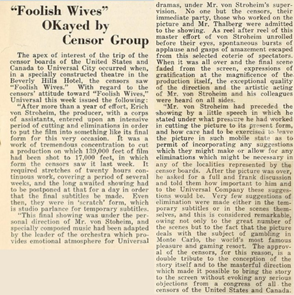
Securing approval from the censors for the picture had by no means been assured, as its director and star, Erich von Stroheim, had delivered a decidedly racy piece of work. Its story of the conquests of a sexually predatory Lothario was presented with uncommon frankness, which is why the studio thought it best to hold a special screening for censors to determine whether cuts would need to be made prior to the general release of the film.
But censorship worries were far from the only headaches associated with this production. Reining in the fractious and headstrong Stroheim had proved to be a protracted and frustrating travail for the front office.
Stroheim was the embodiment of the stereotype of the imperious, tyrannical Hollywood director. Strutting, swaggering, endlessly demanding, an obsessive perfectionist who would brook no dissent from his lordly pronouncements, he was accustomed to having things his way and he would be damned if any carping from the front office was going to change that.
This in itself might have been tolerable if his demands had not been so extravagant. Just for starters, for FOOLISH WIVES he had ordered a full-sized reproduction of the plaza at Monte Carlo constructed. He worked his crew unconscionably long hours and disdained the usual Hollywood concessions to make-believe, insisting on using real champagne and caviar for banquet scenes rather than the more frugal ginger ale and blackberry jam. Rumor has it that he even insisted that actors playing aristocrats be given monogrammed silk underwear that the camera would never see so that they would feel more in tune with their roles.
The industry up to this point had tacitly encouraged this kind of autonomy for big-name directors. Before leaving to produce independently, D.W. Griffith had operated his own production unit while working for Biograph, comfortably functioning as a sovereign potentate with minimal front-office interference. Similarly, Cecil B. De Mille was able to run his production unit more or less as a private fiefdom. Given these kinds of precedents, it had begun to seem that it should be accepted practice for directors with a track record of box office success to enjoy complete autonomy.
At the same time, there was a counterbalance to this trend in the form of the top-down management style pioneered by Thomas H. Ince at his “Inceville” production facility. The directors who worked for Ince received a script that had been personally and thoroughly vetted by Ince and was stamped “shoot as written.”
During much of the decade of the 1910s, the top-down management model co-existed with the special bubble of autonomy for elite directors in a more or less balanced state of equilibrium. But that balance was about to tip decisively, and Stroheim would become the fulcrum of that tilt. The tide that would compel this industry sea change was, unsurprisingly, a financial one.
The end of the 1910s and the beginning of the 1920s had seen a significant shift in movie industry financing practices. In the earliest days, a movie studio head was, as likely as not, a clever entrepreneur who had managed to accumulate a tidy sum running a chain of nickelodeons and decided to risk it on making the leap to movie production. With the chutzpah of a riverboat gambler, this entrepreneur would finance his own productions, raking in the profits from the hits and standing the losses from the flops. But by around 1919, the stakes had grown too enormous to continue in this manner. Longer, more expensive films had become the norm, which meant a greater risk riding on each release. Moreover, the larger studios had begun to move into the exhibition end of the business, buying up chains of theaters in order to guarantee an exhibition outlet for their product. There was no longer a reasonable alternative to seeking financing from investment bankers. Wall street had initially been understandably wary of investing in this fledgling industry, but by the late 1910s there was no longer any doubt as to the potential profitability of films – especially those that featured the immensely popular actors who had become known as “movie stars.” The December 19, 1919 edition of “Variety” had affirmed the degree to which Wall Street had bought into Hollywood:
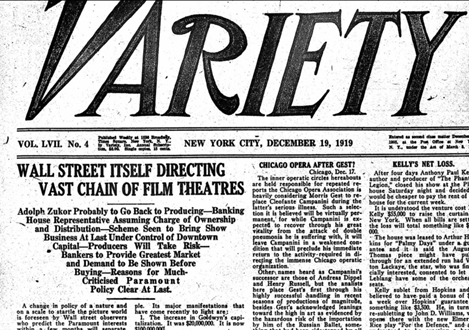
Clearly, Wall Street investors were not about to stand for extravagant excesses on the part of starry-eyed “artiste” directors who prioritized aesthetic purity over the bottom line. Stroheim’s inflexible spendthrift ways placed him squarely in the crosshairs of this interdict. All that was needed was a studio executive with the tenacity to rein him in.
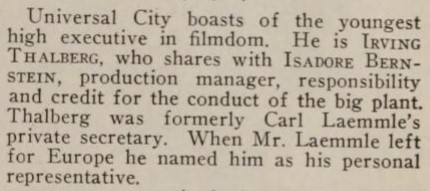
That executive was Universal’s Irving Thalberg. A bright and ambitious youngster, Thalberg had found work in the New York office of Universal right out of high school, rising quickly from an entry level job to the position of personal secretary to Carl Laemmle, the head of the company. In this capacity, he impressed Laemmle so profoundly that in short order Laemmle made him head of production at the Los Angeles studio. An article in the September 25, 1920 edition of “Exhibitors Herald” took note of his exceptional youthfulness among the ranks of top industry executives:
Less than a year later, in its July 8, 1921 edition, “Variety” included in an assessment of the current state of Hollywood productions a bold assertion that this young dynamo intended to bring a new stability to the industry:
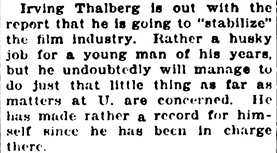
He would, in time, be instrumental in doing just that, but first he would have to solve the problem of Stroheim’s arrogant intransigence.
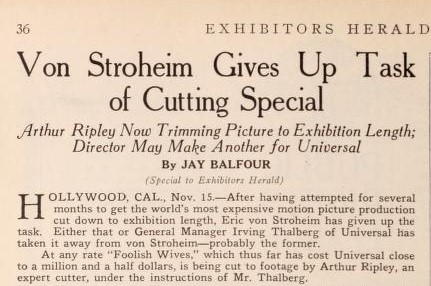
Stroheim had been accustomed to getting his way through bluster and intimidation, but Thalberg was not easily bullied. When Stroheim’s shooting schedule became more and more protracted, seemingly without end, Thalberg reviewed the existing footage, determined that there was enough there to tell a coherent story, and ordered Stroheim to stop filming additional scenes. When Stroheim ignored the order and continued shooting, Thalberg sent studio employees to confiscate the cameras and lights, effectively shutting down the production. That left the problem of editing the project. Stroheim had shot over 300 reels of film – well upwards of 50 hours of footage. He edited this down to 17 reels, a running time of over 3 hours. (This was the version that had been screened for the censors.) Thalberg, finding this unacceptably long for theatrical exhibition, ordered further cuts. When Stroheim refused, Thalberg took the footage away from him and had it recut by Arthur Ripley. The November 26, 1921 edition of “Exhibitors Herald” did its best to phrase its reporting on the matter delicately:
Ironically, Thalberg was not yet done jousting with Stroheim over a gigantic production going off the rails. In 1923, Thalberg left Universal to go to work for Louis B. Mayer Productions as a vice president in charge of production. Soon thereafter, Mayer’s company became part of the merger that created Metro-Goldwyn-Mayer. And one of the productions that Thalberg inherited as part of the merger was a massive Goldwyn Pictures project called GREED. This was the current pet project of Stroheim, who had left Universal for the greener pastures of Goldwyn in an effort to get away from the heavy-handed oversight that had hobbled him at Universal.
Neither man could have been happy about this turn of events. Sure enough, they butted heads again, as Stroheim turned in an initial 10-hour version of GREED, which he then whittled down to a mere 7 hours. But by this time the tide in the industry had turned more decisively against maverick directors and in favor of the front office brass. Stroheim was compelled to cut the film further, down to a 4-hour running time. When told that this still was not adequate, Stroheim dug in his heels and refused to cut it further, whereupon the film was summarily taken entirely out of his hands and reduced to a more manageable 2 ½ hour version for theatrical release.
The original “director’s cut” of GREED was thereby lost to posterity, ground under the wheels of an unstoppable juggernaut of studio bureaucracy. There was a new sheriff in town, a tough enforcer by the name of Wall Street, and henceforth the artistic inspirations of virtuoso directors would be tempered by the imperatives of sound business practices. Moreover, the Hollywood moguls who directly oversaw productions in the Los Angeles studios would now be directly answerable to the money men based in New York City. There would still be the occasional runaway production that would get out of hand and cause a financial train wreck – the ill-fated silent version of BEN-HUR at MGM is a prime example – but these would be corporate missteps, not the result of an unchecked rogue director in reckless pursuit of an epic magnum opus. With the decisive ascension of fiscal discipline over artistic license in Hollywood, the stage was set for the well-oiled machine that would be the studio system of the 1930s.
