
One century ago this week, the July 15, 1921 edition of “Variety” carried an announcement of a forthcoming film from Charlie Chaplin:
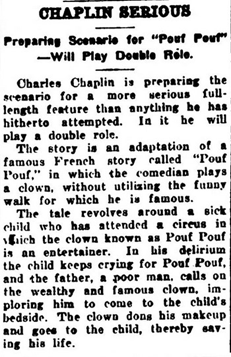
If you thought you were familiar with all of Chaplin’s films, but find that you can’t seem to place POUF POUF, don’t worry. The film was never actually made.
The apparently somber undertone of the prospective project was, however, very much in keeping with a particular aspect of Chaplin’s work. From the time he left Keystone, where knockabout, rapid-fire gags and mayhem-filled chases generally crowded out any semblance of sentiment or pathos, Chaplin had shown an interest in tempering his pratfalls and comic pantomime with a leavening of straight drama.
Upon making the move from Keystone to Essanay, he lost no time in using his expanded creative autonomy to moderate the pacing of his films and to introduce dramatic elements alongside the gags. This is particularly apparent in such Essanay two-reelers as THE TRAMP and THE VAGABOND.
Still, the 20-minute two-reel format of the films Chaplin had contracted to produce for Essanay imposed limitations on his dramatic ambitions. Two-reel films were an ideal length for typical slapstick comedies, in which a minimal narrative need only serve as a clothesline on which to hang a series of gags, but dramatic narrative elements need room to breathe. It is not surprising, therefore, that Chaplin set his sights on creating longer films — feature length films — very early on in his career.
In 1915, while still working for Essanay, he conceived of and actually began work on a feature length film to be called LIFE. This would have been a largely autobiographical portrait of his impoverished early life experiences. But shooting a feature film takes considerably longer than shooting a two-reel comedy, and the pressure to keep theaters regularly supplied with new Chaplin films was intense. His films were doing a land office business for exhibitors, so consequently the market was hungry for more product, and the sooner the better. Essanay was willing to indulge their valuable employee up to a point, but eventually they had to call a halt to the production of LIFE and hold Chaplin to the terms of his contract by putting him back to work on the two-reel productions for which he had been hired.
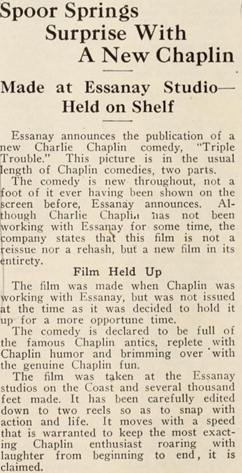
LIFE would not have been a straight drama, but rather a drama with comic elements. We can get a sense of what the film would have been because some of the footage shot for LIFE was salvaged for use in Chaplin’s two-reel comedy POLICE. Moreover, even more of the discarded LIFE footage was used in an Essanay release called TRIPLE TROUBLE, which was cobbled together out of unused odds and ends after Chaplin had left Essanay and then released as a “new” Chaplin film without his participation.
“Exhibitors Herald and Motography” announced the release in its August 3, 1918 issue (the Spoor referenced in the headline is George K. Spoor, whose surname initial was the “ess” in “Essanay”):
This prompted an angry denial from Chaplin, who was not pleased to see a patchwork of unused footage and outtakes from earlier films represented as his handiwork:
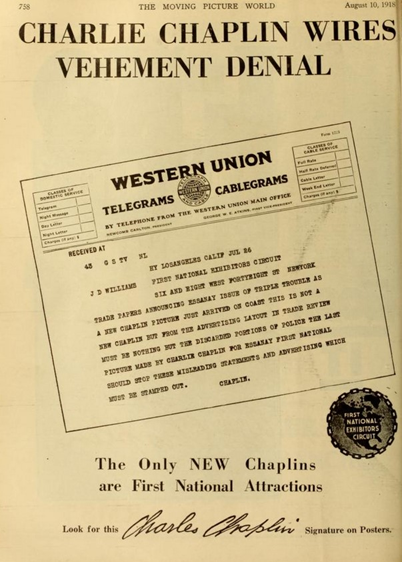
His outrage is understandable, but the fact remains that TRIPLE TROUBLE is a boon to film historians, as it affords us a further glimpse of what the abandoned LIFE project would have been if it had been completed.
When Chaplin was finally able to complete and release a feature length film, THE KID, in 1920, he followed the same formula he had planned for LIFE – a dramatically based story laced with his trademark comedic gags. Indeed, the opening title card of THE KID makes this explicit:
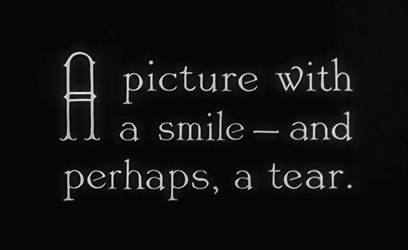
If the proposed POUF POUF project had come to fruition, we can only guess at what the proportion of drama to comedy might have been. The “Variety” article characterizes it as “a more serious full-length feature than anything he has hitherto attempted,” suggesting that viewers might expect fewer smiles and more tears than in THE KID.
What we do know is that the dramatic elements woven into the narrative of THE KID did not entirely satisfy Chaplin’s appetite for creating straight dramatic content. He would go on to write and direct A WOMAN OF PARIS in 1923, which was a purely dramatic production in which he did not appear on camera except for a brief Hitchcockian walk-on.
After A WOMAN OF PARIS, Chaplin’s interest in producing straight drama continued unabated. In fact, a July 17, 1926 article in “Exhibitors Herald” made the startling claim that he was contemplating leaving comedy behind altogether, beginning with a film on the life of Napoleon Bonaparte:
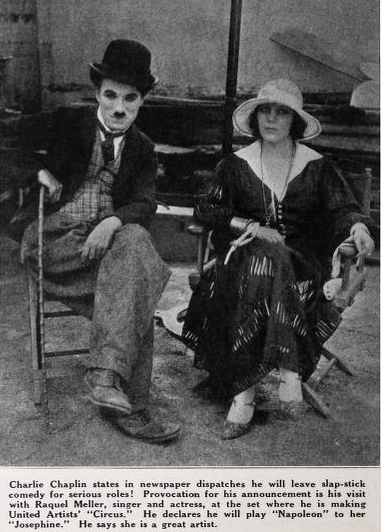
Apparently the Napoleon project was more than a passing fancy, as the January 7, 1928 issue of “Motion Picture News” carried an apparently official announcement indicating that it would indeed be his next film, with shooting scheduled to begin in three months’ time:
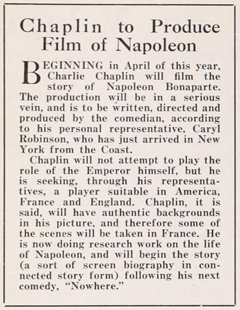
The project never came to fruition, which is probably just as well since Abel Gance had just released an epic cinematic portrayal of the life of Napoleon that was unlikely to be equaled, let alone surpassed, even by an artist of Chaplin’s stature.
Fortunately, he eventually came to realize that an artful blending of the comic and the tragic was best suited to his talents. Certainly in a masterpiece like CITY LIGHTS there is more than enough pathos to satisfy his ambitions as a dramatic filmmaker while still leaving space for some of the most uproarious laughs to be found in any of his films. The picture’s final scene, which is regularly cited as one of the finest scenes ever filmed, is more deeply moving than anything to be found in A WOMAN OF PARIS.
Meanwhile, the idea of the Pagliacci-like sad clown of POUF POUF did not entirely go to waste. Chaplin would circle back to this concept in a somewhat different form for the character of Calvero in LIMELIGHT.
As for the abandoned Napoleon project, it’s possible that Chaplin’s thinking on that may not have been entirely wasted either. Some years later, Chaplin was asked by a reporter if he was still considering making a film about Napoleon. “No,” Chaplin replied, “Napoleon was a dictator. I don’t like dictators.” But of course he did make a film about a dictator, although not about Napoleon. It was not, however, to be a serious dramatic treatment. We can therefore speculate that at some point it occurred to Chaplin that his restlessness to move beyond slapstick comedy could be effectively channeled into satire, comedy’s venomous first cousin.
In THE GREAT DICTATOR, Chaplin mercilessly skewers both Adolph Hitler and Benito Mussolini – not with the bludgeon of heavy drama nor with the light pratfalls of slapstick comedy, but rather with the lethal scalpel of pointed satire. It seems that at some point Chaplin must have come to appreciate the wisdom of Mark Twain’s observation that “power, money, persuasion, supplication, persecution… can lift at a colossal humbug, push it a little, weaken it a little; but only laughter can blow it to rags and atoms at a blast. Against the assault of laughter nothing can stand.” Through satire, Chaplin could have it both ways, making serious films while also employing his genius for comic invention. Seen in this light, such aborted efforts as LIFE, POUF POUF, and the Napoleon project can be regarded not as blind alleys, but rather as mileposts in a necessary progression from slapstick to satire in Chaplin’s growth as an artist.
